 There is nothing new about the news of news being paid for. I first became aware of this practice as a mass communication student in the early 2000s. To me, then, it seemed that it was not just news but the soul that is being bartered. The feeling still holds true.
Even this insignificant blog of mine, has been approached for 'sponsored blogging'. Interestingly, when I refused the money and and gave them a counter offer: That they let me know of topics and ideas that would interest me and I would post about them for free. But it seems that they don't like their work done for free. Strange, isn't it?
Today there was an nice piece in The Sunday Express titled "News, Sponsored." The contents of the article wouldn't be surprising for people who are in the business of the media, we have learnt to take it in our stride. A necessary evil for some.
Friends in the Hindi news channels term such content ad ki khabar (ads as news) and they usually get preference over other genuine news content. Obviously so, because there's money in it.
Such initiatives by the media organisations could be beneficial in these cash-strapped times, but the long term implications may be adverse. News is associated with credibility and when the credibility starts to wash off, so does the bottom line.
Or is it so? There are newspapers that don't give much of a damn to credibility and still sit atop the readership figures. There are news channels that have ceased to be news channels but draw the highest TRPs. We all thought that it was just a passing fad and Indians will tire of such content and see the light. But the light doesn't seem to be coming anytime soon.
Even though being in the media (not the mainstream media, but a wing that'll be the mainstream soon), I have started to rely more on the opinions of individuals who are unassociated with the media: the bloggers, the twitterers, the forums. I think I can still trust them. For me, professionally, it isn't a good signal.
[Image courtesy: The Sunday Express]
Click here for the complete post...
Collapse this post
 ...or at least some people at The Indian Express think so. I wouldn't have otherwise posted about this 'oversight', but for the fact that the news item in question appeared in the 'From the Northeast' page of the newspaper.
The news was about an altercation between two groups of students ('locals' versus 'outsiders') at the North Eastern Hill University (NEHU), my alma mater.
To add to further ignorance, the accompanying photo carries a caption that mentions the name of the university (NEHU) as Sikkim Manipal Institute of Technology. It is possible that this photo is possibly related to another unrelated incident.
The Express is one of the very few national newspapers that give regular coverage to the otherwise neglected North Eastern India and I assume that the people in charge of the page would at least be aware of the geography of the area.
I wouldn't blame the reporter Tilak Rai for the gaffe, Tilak has been reporting from the region for quite some and would know where Shillong is.
Though, on IndianExpress.com, they seem to have made amends to the headline but the body of the story still mentions 'Sikkim'.
All the years I have been away from home, there have been numerous instances when I felt like an unknown Indian. And occassionally we are made to feel by the authorities that we from the North East are different and therefore should adhere to an additional set of rules when in the capital of the country.
For those who didn't take their geography classes in school seriously, Shillong is the capital of the state of Meghalaya located south of Assam. Sikkim is a different state, north of West Bengal and the capital of Sikkim is Gangtok.
Also the largest university in Shillong is the North Eastern Hill University (also known as NEHU), a Central University.
Click here for the complete post...
Collapse this post
Yet another blog exposé of the fallacies of the media (deliberately dropping the adjective 'Indian' as this phenomenon seems universal).
Many newspapers carried a story about a 88-year-old on-the-run Nazi war criminal called Johann Bach being held in Goa and subsequently deported to Germany.
As it turns out it was a hoax planted by Pen Pricks, an anonymous journo-blog from Goa.
To be honest, when I read the story in The Indian Express, I didn't find anything amiss apart from the piano part. I wondered for a while why and how would a criminal on the run for half-a-century (across the globe) lug a piano along with him. Then I moved on to the next story.
To be a little fair to the media, there isn't always enough time to cross check all the facts, especially when you are understaffed and there is a deadline looming. And there is always the risk of inviting the wrath of the boss in case you drop the story while the competition goes ahead with a four-columner. But again, this is what the job demands of you.
And yet again, to so many of my friends, if it is in print (TV credibility is already eroded) it isn't necessarily the truth.
Came across this via K's blog (the inspiration for the title of this post).
Click here for the complete post...
Collapse this post
 The turnaround of the Indian Railways has attracted a lot of attention, both within and outside the country. It is indeed welcome that public sector enterprises are gradually taking their business seriously and adding to the government's kitty. But what goes underreported in all his hype is the consumer's point of view and also the other side of the story
The media has been by and large all gung-ho about the way the world's largest employer is headed, it is only occasionally that we get to read stories like these:
IIM-A study praising Lalu’s Railway turnaround was paid for by Lalu’s Ministry
Though I travel less frequently on the rails than I used to, given the advantages that air has over the rails, my observation is that not much has changed on the ground level. Let me elaborate my woes.
The charges, as usual, are hidden
Last year in a step which the Railways, obviously, didn't announce with much fanfare, enhanced the tatkal quota to 30 per cent. This increase in quota is unlike the one which the Central Government has promised following the widespread protests against the OBC quota in educational institutions. There is no enhancement of seats. If you are booking a little late, you better be ready to pay more.
And that's not all, even the tatkal charges have been hiked. For the peak-season that is 10 months a year, a passenger would have to shell out an addition of Rs 300 for an upper class ticket and Rs 150 for a lower class ticket. Off-season is only two months, when the charges are Rs 200 and Rs 75 respectively. But again, the off-season also has a catch; it is not applicable in trains and classes with average utilisation of 80 per cent.
In case I have to book a ticket in third AC from Delhi to Gwalior under the tatkal quota, I have to pay 66 per cent extra (a regular ticket costs Rs 450). Now that's called a rip-off!
Lalu and his babus were obviously not happy with the extra revenue that this 'innovative' tatkal scheme, requiring only a little tweaking of rules, would bring. There is an additional charge of up to Rs 50 (depending on the journey) if the journey originates from a station other than the one from where the ticket has been issued. I'm trying to grasp the logic behind this move. Please help.
There's more. The Railway Ministry has re-classified hundreds of trains as superfast, while on track they haven't gathered any more speed. The reason, the superfast tag invokes an extra fare from the passengers ranging from Rs 10 to Rs 50, depending on the class of travel. Benefit to the passenger - nil. To the railway balance sheet - millions and millions.
These are only a few that have come to my notice, there would me lots more in the fine print.
Benefits, well...
For the urban middle class the most welcome service of the Indian Railways is undoubtedly Internet reservation. Though there are connectivity issues, incorrect billing and delay in refund (I experienced that), but that is negligible compared to the convenience. The mobile charging points (though too few compared to the number of passengers in a coach) is another thoughtful addition.
The trains run late as usual, the other day my parents while travelling back to Shillong reached Guwahati six hours late. That's not unusual for the Delhi-Guwahati Rajdhani Express.
The pantry service is poor and unhygienic. Errant staff also overcharge passengers and also ask for tips at the end of the journey. For a 28 hour journey (which usually extends to 32 hours or more) passengers on the Guwahati-Delhi Rajdhani Express are provided with only a single one-litre bottle of water!
All the options mentioned in the menu are as-a-rule not available. And rice lovers, inspite of advance requests have to be content with half a bowl of rice and unwanted chappatis.
As a general rule I've found the employees manning the ticket counters and the railway police personnel to be discourteous, with very few exceptions. I once had to threaten a reservation staff at the New Delhi station reservation counter when he was booking other tickets on the sly while we were waiting in the queue for over an hour. The service is excruciatingly slow with most of them more adept at single finger typing.
On another instance when I had to cancel my ticket (at Itarsi railway station) which didn't get confirmed, I had to explain the clerk the cancellation rules and he had to consult his senior for about 15 minutes before telling me that the ticket cannot be cancelled. Later, a friend, who was accompanying me (as I was down with jaundice) had to go to the station master to get it approved.
Ticketless and unreserved passengers still continue to crowd reserved compartments in almost all routes, the travelling ticket examiner meanwhile adds lining to his pockets.
Entering a railway platform is another pain. There's always a huge queue at the platform ticket counter. And often the staff arrives conveniently late, I regularly experience that at Hazrat Nizamuddin. At New Delhi Railway Station there are coin-operated machines for the purpose, but their coin boxes are either full (no one seemingly cares about emptying them) or are malfunctioning. Even the operating procedure isn't clearly elaborated leading to a lot of unnecessary confusion.
This gives me an idea for Lalu to ask his boys to implement. Introduce a SMS platform ticket (since for an amount of Rs 3 online platform ticket wouldn't be a viable idea, the service charges would themselves add to about Rs 30 with additional printing and paper cost). It can have a premium pricing for Rs 6, believe me, people would happily opt for it.
Platforms have dogs roaming around and there are too few chairs where passengers waiting for yet another late train can sit or the dogs can lie under. There are too few fans too. Instead of having an incline (which would benefit everyone including the disabled) there are stairs and more stairs all around.
Lalu has shown everyone the money, but I as a consumer am yet to reap benefits that would justify the extra that I'm being charged for. I don't mind paying as long as it is worth paying for. But then it is difficult to fight a monopoly and that too a 150-year old behemoth with a surplus of Rs 200 billion.
If you think that I, seemingly belonging to the new upwardly mobile class, am anti-railway, do read this post. But then I'd rather plan my vacations in advance and fly (at competitive prices) than wait for the green signal at outer.
[The fare information mentioned in this post has been sourced from the Indian Railways website indianrail.gov.in]
Related posts:
* Bhopal Expressed
* Chugging Along
* Tracks to Nowhere
* Railway Regulations
Click here for the complete post...
Collapse this post
In a blatant act of self-promotion if I were to highlight a blurb on the side panels of this blog, then this does sound good:
"We recommend this tea" - The Sunday Indian Express
Since I don't intend to be very clamant about this, but at the same time being unable to hide my glee, I'm posting a post instead.
This blog was reviewed in today's edition of
The Sunday Indian Express and they had some good things to say and I'm pleased. I couldn't find the same posted on their website (where many links on the home page lead to dead ends), but they do have it in the epaper.
AD WISE
A lowdown on the top-ranking Indian blogs
CUTTING THE CHAI
(http://soumyadipc.blogspot.com)
 It's a pitch black screen with bright yellow strips and a silhouette of the Red Fort which fails to mitigate the starkness. Visually, the site rightfully reflects its contents. For, Cutting the Chai is an explosion, a riot of thought, videos and downloads, For Soumyadip, the creator, this blog is a tribute to Indian advertising talent: from the black-and-white prints of the 1940s to the recent controversial Amul underwear ad.
Though this blog has a large repository of amusing and entertaining ads, a running commentary on each picture makes the entire experience hilarious. The author fully exploits the blog platform by providing videos of each TV ad he picks. In some cases, ringtone downloads are also added so that the reader can hear his favourite jingle every time the phone rings. This Chai has other flavours as well: movie reviews, mobile phone releases, among others. We recommend this tea.
Just a small correction, the ads featured on this blog date back not only to the 1940s
but to the 19th century.
Incidentally, Cutting the
Chai is also the featured blog at India Blogs'
list of top Indian blogs (August 25, 2007). There's some illustrious company that I share the space with. It's humbling.

Click here for the complete post...
Collapse this post

Shekhar Gupta (as always) puts forward an articulated argument why Pratibha Patil is not the right choice for President in his aptly titled column in The Indian Express - National Interest.
Excerpts:
The Congress’ guilt is not so much about who they chose for the job as it is about how it trivialised that job, to begin with...
You have to first decide what the presidency is all about. Is it about political experience? Is it about respect? Or, put another way, is it merely a ceremonial office, or is it an important political office? It cannot be both and that is one more reason the Congress sounds so unconvincing — and unconvinced...
The way the party and its allies - at least those that it consulted - went about selecting the next president, it seemed it was the least important sinecure in the Republic. Now you can’t defend yourselves saying, don’t take notice of any adverse revelations about her, after all, come July 25, and she will represent the glory of the Republic...
And, how’s this for irony? This is the same party that was so exquisitely careful in choosing its prime minister.
More on Pratibha from
The Express:
*
'Tai may become President, what about us who have been cheated?' (June 30, 2007)
*
Probe how bank was sold dirt cheap, file criminal case: order came in April (June 30, 2007)
* '
Govt seriously considering compulsory sterilisation' (June 30, 2007)
*
Her latest gem: 'Mughals respected women so much that purdah came in' (June 29, 2007)
*
After women & veil, it's now dead man talking for Patil (June 27, 2007)
*
Patil was aware of her bank mess, top defaulters her kin (June 27, 2007)
*
BJP says country faces prospect of 'tainted President' (June 27, 2007)
*
Pratibha bank waived loans for kin before RBI shut it down (June 25, 2007)
*
Forcible sterilisation of those with hereditary disease: Pratibha Patil's 'Emergency' idea (June 24, 2007)
*
Clarify on Rajani's allegations, says BJP (June 24, 2007)
*
Congman's wife drags Pratibha name into allegations, NDA distances itself (June 23, 2007)
*
Sugar mill started by Patil sealed for loan default (June 23, 2007)
*
Patil’s purdah remark courts controversy (June 19, 2007)
*
Pratibha who? (June 17, 2007)
*
CV of first would-be ‘woman President’: backed Indira, backed by Rajiv (June 15, 2007)
Previously on Cutting the
Chai:
*
Pratibha Patil: Who, Why?[Image courtesy: The Indian Express]
Click here for the complete post...
Collapse this post
 The Department of Posts is slowly reinventing itself. Though most of the 155,618 post offices (as on March 31, 2003) are yet to reflect that. Though much of the processes have been computerised, the pace of the queue remains sluggish. Post offices are usually dingy and dark places with wooden cupboards (gradually replaced by steel), files lying untidily, a bowl of gum in a corner accompanied by bits of perforated paper. A steady sound of the dot-matrix printer printing names of addressees and destinations on bar-coded stickers. And offering services much diverse than the booming private sector banks and an unbeatable network which all the courierwallahs put together cannot beat.
I still have more faith on Speed Post than any of the courier services advertised on television. It's tried and tested. A private courier company charges me Rs 30 for a parcel of 50 grammes to be delivered from Delhi to Shillong. It usually reaches in four days (occasionally seven or eight), one also got lost in transit and my brother took them to the consumer court. Speed Post charges Rs 25 (a flat rate across the country) and the delivery is within 72 hours (the distance is more than 2000 kilometres).
Though the Indian Railways and the man at the helm, Lalu Prasad Yadav, might attract international B-school attention for the turnaround of the railways. As a passenger I do not see any drastic changes. The trains still run late, the berths are uncomfortable, the toilets stink, the food is bad. Only difference is in the ease of ticketing. But that had been on for quite some time now and the credit shouldn't go the incumbent minister. The revenues may rise, but I would still prefer to fly in an Air Deccan flight (even though it might have been overbooked). I reach my destination the same day, not two days later, at the same price. Given that I and many others like me prefer India Post, Dayanidhi Maran, might as well be lecturing Ivy League students.
Though India Post still has a long way to go, I was pleasantly surprised to find its ad in both The Times of India and The Indian Express (might have appeared in other papers too) and the agency name in fine print (wondering for the appropriate term) said DAVP. Not exactly known for quality in advertising, the Directorate of Advertising and Visual Publicity got some good work done this time.
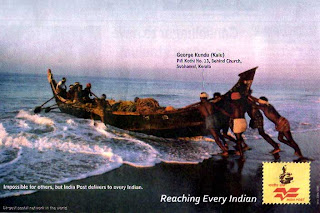
[Click on image for a detailed view]
The copy reads:
George Kundu (Kalu)
Pili Kothi No. 13, Behind Church,
Subhawal, Kerala
Impossible for others, but India Post delivers to every Indian.
Reaching every Indian. India Post
Largest postal network in the world.
[Ad scanned from The Indian Express, March 28, 2007]
Click here for the complete post...
Collapse this post