Cutting the Chai has moved to a new domain: cuttingthechai.com.
You can get in touch with Soumyadip at www.soumyadip.com.

Sunday, December 20, 2009

Ads for Oral Sex!

One day, in the comparatively innocent times that we grew up in, a friend announced, "I had oral sex." I and another friend present were stupefied. We were still in school. "Come, again," (no pun intended) we said. He repeated the four shattering words again, with extra emphasis.

Curious, we prodded for details and it turned out that our 'sexually gratified' pal had just talked a bit about sex with a girl on the phone. Being more enlightened, courtesy the agony column in The Teenager and quite a few magazines that we weren't exactly supposed to read then, we let our naive friend know of the dictionary meaning of oral sex.

But the times they have changed. When school kids nowadays talk of love, it isn't always platonic, as in our times (Damn, I already feel old).

Ads for oral sexEven newspapers do not shy away from advertising for fellatio services, as I discovered today. The massage parlour and escort services ads have been around for many years. Objections were raised, but such ads still fill in many column centimetres of the classifieds pages.

Since I'm on the look out for a new house, was scanning Times Classifieds, that comes along with the Sunday Times of India for properties. Under the 'Massage Parlours' head I discovered at least two ads quite brazenly peddling oral sex services. Only they interchanged a couple of letters (blowjob becomes blwojob), taking a cue from the spammers.

BANGKOK-STYLE-YOU-WORLD.CLASS Blwojob Ser Like Beautiful Charming Good Looking girl fully trained service staff CALL ASSH # 99********

REFRESHING.YOU-WORLD.CLASS Blwojob Ser By Beautiful Charming Good looking girl fully trained service staff Call KASHISH. 98********
Is it just me, or is there a striking similarity between the wordings of matrimonial ads and the ones above?

What's next? Fcuk!

(This could have been around for longer, just that I happened to notice it today)

This is one dhandha that doesn't go manda. Though I support legalising prostitution and quite agreed with the Supreme Court's observations on legalising the trade, but it isn't as easy a solution. Make a law and expect the world to fall in order.

The anti-legalising prostitution argument also makes sense (not the it's-against-our-culture kinds).

Kinda confusing.

Click here for the complete post...

Sunday, December 06, 2009

When News is Sold

News, SponsoredThere is nothing new about the news of news being paid for. I first became aware of this practice as a mass communication student in the early 2000s. To me, then, it seemed that it was not just news but the soul that is being bartered. The feeling still holds true.

Even this insignificant blog of mine, has been approached for 'sponsored blogging'. Interestingly, when I refused the money and and gave them a counter offer: That they let me know of topics and ideas that would interest me and I would post about them for free. But it seems that they don't like their work done for free. Strange, isn't it?

Today there was an nice piece in The Sunday Express titled "News, Sponsored." The contents of the article wouldn't be surprising for people who are in the business of the media, we have learnt to take it in our stride. A necessary evil for some.

Friends in the Hindi news channels term such content ad ki khabar (ads as news) and they usually get preference over other genuine news content. Obviously so, because there's money in it.

Such initiatives by the media organisations could be beneficial in these cash-strapped times, but the long term implications may be adverse. News is associated with credibility and when the credibility starts to wash off, so does the bottom line.

Or is it so? There are newspapers that don't give much of a damn to credibility and still sit atop the readership figures. There are news channels that have ceased to be news channels but draw the highest TRPs. We all thought that it was just a passing fad and Indians will tire of such content and see the light. But the light doesn't seem to be coming anytime soon.

Even though being in the media (not the mainstream media, but a wing that'll be the mainstream soon), I have started to rely more on the opinions of individuals who are unassociated with the media: the bloggers, the twitterers, the forums. I think I can still trust them. For me, professionally, it isn't a good signal.

[Image courtesy: The Sunday Express]

Click here for the complete post...

Friday, September 11, 2009

By the way, Shillong is in Sikkim

Indian Express Mixes Shillong with Sikkim...or at least some people at The Indian Express think so. I wouldn't have otherwise posted about this 'oversight', but for the fact that the news item in question appeared in the 'From the Northeast' page of the newspaper.

The news was about an altercation between two groups of students ('locals' versus 'outsiders') at the North Eastern Hill University (NEHU), my alma mater.

To add to further ignorance, the accompanying photo carries a caption that mentions the name of the university (NEHU) as Sikkim Manipal Institute of Technology. It is possible that this photo is possibly related to another unrelated incident.

The Express is one of the very few national newspapers that give regular coverage to the otherwise neglected North Eastern India and I assume that the people in charge of the page would at least be aware of the geography of the area.

I wouldn't blame the reporter Tilak Rai for the gaffe, Tilak has been reporting from the region for quite some and would know where Shillong is.

Though, on IndianExpress.com, they seem to have made amends to the headline but the body of the story still mentions 'Sikkim'.

All the years I have been away from home, there have been numerous instances when I felt like an unknown Indian. And occassionally we are made to feel by the authorities that we from the North East are different and therefore should adhere to an additional set of rules when in the capital of the country.

For those who didn't take their geography classes in school seriously, Shillong is the capital of the state of Meghalaya located south of Assam. Sikkim is a different state, north of West Bengal and the capital of Sikkim is Gangtok.

Also the largest university in Shillong is the North Eastern Hill University (also known as NEHU), a Central University.

Click here for the complete post...

Tuesday, September 08, 2009

Hindustan Times: Hitting the paper on the head

Hindustan Times It Is Time CampaignHindustan Times seems to have a thing for makeovers. I remember seeing atleast four different avatars of the newspaper.

Good. Change is good.

Though I didn't quite like their print campaign advertising the all new Hindustan Times, their short TV ads do make a point and hit the paper right on the head, literally.

Here are four TVCs from the Hindustan Times 'it is time' campaign.

Ironically, the 'Better Journalism' ad is also being aired on news channels.

Better Journalism


Open Our Minds


Stop Panicking


Being Cynical

Click here for the complete post...

Wednesday, February 25, 2009

The Power of Knowledge

The Economic Times - The Power of Knowledge
The Economic Times
The Power of Knowledge


Knowledge is man's (in this case a cat's) most valuable asset. And this is what this cat=and-a-leashed-dog ad for The Economic Times attempts to stress upon.

This is from the early 2000s and I had clipped and stored it in a file. It probably appeared in The Sunday Times of India.

Agency: Enterprise Nexus

Click here for the complete post...

Thursday, November 13, 2008

London International Awards - Indian Winners

London International AwardsIndian advertising agencies put up a decent show at the London International Awards 2008.

Leo Burnett picked up the maximum metals. It won nine of the 11 nominations it achieved. Unsurprisingly, eight of the nine awards were for the Luxor Highlighter campaign: three golds for Che, Charlie and Hitler in the Design category and two golds for Highlight What is Important – Pink and Blue in the Print category. Che, Charlie and Hitler won a silver each in the Print category, while Tide Detergents picked up a silver in the Consumer Campaign sub-category in Print.

O&M Mumbai won three silvers, two for its work for Neo Sports in the Campaign and Media Promotion sub-category in Television/Cinema. The third silver was brought home by the Videocon Integra Wide Screen TV campaign in the Radio category.

Production house Nirvana Films won a silver for its work on Neo Sports in the Television/Cinema category.

A showcase of the winning entries from India:

Luxor Highlighter Che
Category: Design - Poster
Award: Gold
Category: Category: Print - Office Equipment
Award: Silver
Ad: "Che"
Agency: Leo Burnett India, Mumbai
Product: Luxor Highlighters
Client: Luxor Writing Instruments Pvt Ltd
Chief Creative Officer: KV Sridhar
Executive Creative Director: Santosh Padhi
Creative Director: Santosh Padhi
Copywriter: Russell Barrett
Art Director: Santosh Padhi
Illustrator: Kunal Mhabadi


Luxor Highlighter Chaplin
Category: Design - Poster
Award: Gold
Category: Category: Print - Office Equipment
Award: Silver
Ad: "Charlie"
Agency: Leo Burnett India, Mumbai
Product: Luxor Highlighters
Client: Luxor Writing Instruments Pvt Ltd
Chief Creative Officer: KV Sridhar
Executive Creative Director: Santosh Padhi
Creative Director: Santosh Padhi
Copywriter: Russell Barrett
Art Director: Santosh Padhi
Illustrator: Kunal Mhabadi


Luxor Highlighter Hitler
Category: Design - Poster
Award: Gold
Category: Category: Print - Office Equipment
Award: Silver
Ad: "Hitler"
Agency: Leo Burnett India, Mumbai
Product: Luxor Highlighters
Client: Luxor Writing Instruments Pvt Ltd
Chief Creative Officer: KV Sridhar
Executive Creative Director: Santosh Padhi
Creative Director: Santosh Padhi
Copywriter: Russell Barrett
Art Director: Santosh Padhi
Illustrator: Kunal Mhabadi


Luxor Highlighter Pink
"Every daily newspaper is chockablock with news. People in fact tend to scan each page and read only what is important. We just decided to help them do that better. Luxor Highlighters tied up with a National Newspaper who agreed to hiighlight only the salient parts of every article on a particular page. Our team worked closely with the editorial team in coming uo with innovative and intrinsically true stories within the larger story. The promotion touched the consumer at exactly the right time and at just the right place."

Category: Print - Office Equipment
Award: Gold
Ad: "Highlight What's Important - Pink"
Agency: Leo Burnett India, Mumbai
Product: Luxor Highlighters
Client: Luxor Writing Instruments Pvt Ltd
Chief Creative Officer: KV Sridhar
Executive Creative Director: Santosh Padhi
Copywriters: Russell Barrett/Santosh Padhi
Art Director: Santosh Padhi
Illustrator: Kunal Mhabadi


Luxor Highlighter Blue
Category: Print - Office Equipment
Award: Gold
Ad: "Highlight What's Important - Blue"
Agency: Leo Burnett India, Mumbai
Product: Luxor Highlighters
Client: Luxor Writing Instruments Pvt Ltd
Chief Creative Officer: KV Sridhar
Executive Creative Director: Santosh Padhi
Copywriters: Russell Barrett/Santosh Padhi
Art Director: Santosh Padhi
Illustrator: Kunal Mhabadi


Tide Lipstick
The centre spread of a magazine was stuck with each other with post-it glue
On opening the page the reader saw the stain stuck to the t-shirt
Post-it glue was applied on the lipstick
On further opening the page the reader could easily remove the stain off the garment


The centre spread of a magazine was innovately used to communicate a fresh new idea for Tide. The left half of the centre spread had the visual of the supposedly stained garment and the other half had the visual of a secretary with red lipstick. The lipstick was stuck to tha garment with the help of post-it glue. When the reader tried to open the page, he could easily remove the lipstick stain off the garment. This laid emphasis to our core proposition, 'Put stains back where they belong'."

Category: Print - Consumer Campaign
Award: Silver
Ad: "Lipstick"
Agency: Leo Burnett India, Mumbai
Client: Procter & Gamble
Agency: Leo Burnett India, Mumbai
Chief Creative Officer: KV Sridhar
Executive Creative Director: Santosh Padhi
Copywriter: Santosh Padhi
Art Director: Santosh Padhi
Photographer: Amol Jadhav
Illustrator: Bhushan Patil


Tide Ketchup
"The centre spread of a magazine was stuck with each other with post-it glue
On opening the page the reader saw the stain stuck to the t-shirt
Post-it glue was applied on the ketchup
On further opening the page the reader could easily remove the stain off the garment


The centre spread of a magazine was innovately used to communicate a fresh new idea for Tide. The left half of the centre spread had the visual of the supposedly stained garment and the other half had the visual of a boy spilling ketchup from his burger. The ketchup was stuck to tha garment with the help of post-it glue. When the reader tried to open the page, he could easily remove the ketchup stain off the garment. This laid emphasis to our core proposition, 'Put stains back where they belong'."

Category: Print - Consumer Campaign
Award: Silver
Ad: "Ketchup"
Agency: Leo Burnett India, Mumbai
Client: Procter & Gamble
Agency: Leo Burnett India, Mumbai
Chief Creative Officer: KV Sridhar
Executive Creative Director: Santosh Padhi
Copywriter: Santosh Padhi
Art Director: Santosh Padhi
Photographer: Amol Jadhav
Illustrator: Bhushan Patil


Tide Icecream
"The centre spread of a magazine was stuck with each other with post-it glue
On opening the page the reader saw the stain stuck to the t-shirt
Post-it glue was applied on the ice-cream
On further opening the page the reader could easily remove the stain off the garment

The centre spread of a magazine was innovately used to communicate a fresh new idea for Tide. The left half of the centre spread had the visual of the supposedly stained garment and the other half had the visual of a girl having an ice-cream.

The ice-cream was stuck to tha garment with the help of post-it glue. When the reader tried to open the page, he could easily remove the ice-cream stain off the garment. This laid emphasis to our core proposition, 'Put stains back where they belong'."


Category: Print - Consumer Campaign
Award: Silver
Ad: "Ice Cream"
Agency: Leo Burnett India, Mumbai
Client: Procter & Gamble
Agency: Leo Burnett India, Mumbai
Chief Creative Officer: KV Sridhar
Executive Creative Director: Santosh Padhi
Copywriter: Santosh Padhi
Art Director: Santosh Padhi
Photographer: Amol Jadhav
Illustrator: Bhushan Patil


Download audio [MP3 157 KB 00:00:20 64kbps Stereo 44 kHz]
Category: Radio
Award: Silver
Ad:"Gunshot"
Agency: Ogilvy & Mather, Mumbai
Client: Videocon Industries Ltd
Chief Creative Officer: Piyush Pandey
Executive Creative Director: Sumanto Chattopadhyay
Creative Director: Shekhar Jha
Copywriter: Karn Singh
Agency Producer: Diya Lahiri
Production Company: Musica, Mumbai
Recording Studio: Eardrum, Mumbai
Audio Engineer: Dereck
Sound Design Company: Eardrum, Mumbai
Sound Design By: Dereck
Voice-Over: Manoj Shetty


Download audio [MP3 274 KB 00:00:35 64kbps Stereo 44 kHz]
Category: Radio
Award: Silver
Ad: "Soap Opera"
Agency: Ogilvy & Mather, Mumbai
Client: Videocon Industries Ltd
Chief Creative Officer: Piyush Pandey
Executive Creative Director: Sumanto Chattopadhyay
Creative Director: Shekhar Jha
Copywriter: Karn Singh
Agency Producer: Diya Lahiri
Production Company: Musica, Mumbai
Recording Studio: Eardrum, Mumbai
Audio Engineer: Dereck
Sound Design Company: Eardrum, Mumbai
Sound Design By: Dereck
Voice-Over: Manoj Shetty/Juhi Chatturvedi


Download audio [MP3 352 KB 00:00:45 64kbps Stereo 44 kHz]
Category: Radio
Award: Silver
Ad: "Table Tennis"
Agency: Ogilvy & Mather, Mumbai
Client: Videocon Industries Ltd
Chief Creative Officer: Piyush Pandey
Executive Creative Director: Sumanto Chattopadhyay
Creative Director: Shekhar Jha
Copywriter: Karn Singh
Agency Producer: Diya Lahiri
Production Company: Musica, Mumbai
Recording Studio: Eardrum, Mumbai
Audio Engineer: Dereck
Sound Design Company: Eardrum, Mumbai
Sound Design By: Dereck
Voice-Over: Manoj Shetty


Download video [00:01:31 FLV 1.92 MB]
Download hi-res video [00:01:31 AVI 4.96 MB]
Download for mobile [00:01:31 3GP 1.66 MB]

Category: Television & Cinema
Award: Silver
Ad: "Gas"
Agency: Ogilvy & Mather, Mumbai
Client: Neo Sports Broadcast Pvt Ltd
Chief Creative Officer: Piyush Pandey
Group Creative Director: Sagar Mahabaleshwarkar
Associate Creative Director: Ramamurthy S
Copywriters: Ramamurthy S/Vinod Sudheer/Gururaj Rao/Sweta Ghorawat
Agency Producer: Deepa Limaye
Production Company: Nirvana Films, Bangalore
Executive Producer: Mekala Krishnaswamy
Producer: Mekala Krishnaswamy
Director: Prakash Varma
Director of Photography: PS Vinod/Tassaduq
Editor: Sally Salgaonkar
Sound Design Company: Famous Studios - Darshan VG, Mumbai
Sound Design: Nirvana Films
Music Arrangers: Rupert Fernandes/Anandh Ranganathan


Download video [00:02:01 FLV 2.62 MB]
Download hi-res video [00:02:01 AVI 6.74 MB]
Download for mobile [00:02:01 3GP 2.27 MB]

Category: Television & Cinema
Award: Silver
Ad: "Rusty Nail"
Agency: Ogilvy & Mather, Mumbai
Client: Neo Sports Broadcast Pvt Ltd
Chief Creative Officer: Piyush Pandey
Group Creative Director: Sagar Mahabaleshwarkar
Associate Creative Director: Ramamurthy S
Copywriters: Ramamurthy S/Vinod Sudheer/Gururaj Rao/Sweta Ghorawat
Agency Producer: Deepa Limaye
Production Company: Nirvana Films, Bangalore
Executive Producer: Mekala Krishnaswamy
Producer: Mekala Krishnaswamy
Director: Prakash Varma
Director of Photography: PS Vinod/Tassaduq
Editor: Sally Salgaonkar
Sound Design Company: Famous Studios - Darshan VG, Mumbai
Sound Design: Nirvana Films
Music Arrangers: Rupert Fernandes/Anandh Ranganathan


Download video [00:02:01 FLV 2.57 MB]
Download hi-res video [00:02:01 AVI 6.56 MB]
Download for mobile [00:02:01 3GP 1.66 MB]

Category: Television & Cinema
Award: Silver
Ad: "Presence"
Agency: Ogilvy & Mather, Mumbai
Client: Neo Sports Broadcast Pvt Ltd
Chief Creative Officer: Piyush Pandey
Group Creative Director: Sagar Mahabaleshwarkar
Associate Creative Director: Ramamurthy S
Copywriters: Ramamurthy S/Vinod Sudheer/Gururaj Rao/Sweta Ghorawat
Agency Producer: Deepa Limaye
Production Company: Nirvana Films, Bangalore
Executive Producer: Mekala Krishnaswamy
Producer: Mekala Krishnaswamy
Director: Prakash Varma
Director of Photography: PS Vinod/Tassaduq
Editor: Sally Salgaonkar
Sound Design Company: Famous Studios - Darshan VG, Mumbai
Sound Design: Nirvana Films
Music Arrangers: Rupert Fernandes/Anandh Ranganathan

Click here for the complete post...

Tuesday, September 16, 2008

The Advertising Express

The Indian Express is one of the newspapers that land on my doorstep every morning. I find it to be one of the better dailies around. Like other media outlets the Express also publishes, from time to time, self-promotional ads.

I find the ongoing campaign appealing, because of its simplicity and the strong conect with the brand value. Here are they:

The Influential Express
Not politically correct.
But political and correct.
The Influential Express


The Intelligent Express
Not the average paper.
Because you're not the average reader.
The Intelligent Express


The Investigative Express
Grey matter in black and white.
The Investigative Express


The Incisive Express
Where opinion leaders get their opinion from.
The Incisive Express


The Impartial Express
We put the ink in think.
The Impartial Express


The Impartial Express
The Left thinks we are Right
The Right thinks we are Left
The Impartial Express


The Influential Express
The first thing on the agenda
For those who set one
The Influential Express

The Investigative Express
You care
That's why we dare
The Investigative Express


Agency: Vyas Giannetti Creative

Click here for the complete post...

Tuesday, July 01, 2008

Don't (Always) Trust the Media

Yet another blog exposé of the fallacies of the media (deliberately dropping the adjective 'Indian' as this phenomenon seems universal).

Many newspapers carried a story about a 88-year-old on-the-run Nazi war criminal called Johann Bach being held in Goa and subsequently deported to Germany.

As it turns out it was a hoax planted by Pen Pricks, an anonymous journo-blog from Goa.

To be honest, when I read the story in The Indian Express, I didn't find anything amiss apart from the piano part. I wondered for a while why and how would a criminal on the run for half-a-century (across the globe) lug a piano along with him. Then I moved on to the next story.

To be a little fair to the media, there isn't always enough time to cross check all the facts, especially when you are understaffed and there is a deadline looming. And there is always the risk of inviting the wrath of the boss in case you drop the story while the competition goes ahead with a four-columner. But again, this is what the job demands of you.

And yet again, to so many of my friends, if it is in print (TV credibility is already eroded) it isn't necessarily the truth.

Came across this via K's blog (the inspiration for the title of this post).

Click here for the complete post...

Wednesday, February 27, 2008

TOI Story on e-Ticketing: A Distorted Perspective

Yesterday, The Union Minister for Railways Lalu Prasad Yadav tabled a populist Railway Budget for the next financial year in the Parliament and this morning the papers (expectedly) were full of reports on that. Some adulatory, some critical and a quite a few cynical.

Amidst the melee of reports, most of which I just glanced through, I found one on page two of The Times of India (Delhi edition) which made me think. Not because it was an intriguing write-up but because it was an example of present-day standards of journalism (I too am a part of this).

The report headlined "E-ticketing yet to net passengers" doesn't carry a by-line, it is attributed to Times News Network.

I too am one of those who don't buy in whole the Great Indian Railways Turnaround Story, but this is not the manner in which I would like to package my argument.

The report says:

However, at present, a measly 27 per cent of all bookings are done through the internet.

By what standards can someone term 27 per cent of the millions of bookings done by the Indian Railways as "measly." 27 per cent is more than a quarter, and one-fourth of all reservations done online in a country like India with limited internet penetration is not "measly," it is an achievement.

It goes on further:

But in Delhi alone, the seven ticket vending machines in place now can be used only to procure platform tickets. In addition, thanks to improper maintenance, most of them are lying defunct.

I agree with the "lying defunct" part having experienced that first hand. But who ever filed this story doesn't perhaps understand the fact that the "seven ticket vending machines," are meant to deliver platform tickets only. Not that it is designed to deliver all kinds of tickets and is presently delivering only platform tickets.

Moreover, common sense tells us that since they are coin operated, you cannot book a sleeper class ticket to Bhopal inserting three hundred rupee coins or one-fifty two-rupee coins (or a combination of both as it doesn't perhaps accept five-rupee coins).

Regarding the first ATM ticket counter it says:
...one has to be registered with the IRCTC

Like it or not, registration is a necessary evil because it helps both - the user and the service providers - to track the transactions made and in case something goes wrong there is an identification procedure to track that.

The story ends with a quote:
"Unless we manage to include all banks under this service, it is going to be difficult to involve all passengers in this scheme. The railways at the moment is happy earning the royalty after lending out prime space to this bank. They are planning similar ATM counters at all important stations in Delhi. Sadly, scant regard is being paid to the profile of the passengers, many of whom have never operated an ATM or a computer in their entire life."

But it isn't attributed to anyone. Should I, as a reader, interpret this as said by one Sashi Kumar who was quoted two paragraphs before? If yes, I shouldn't.

The few places I worked in and the few stories that I filed while working there, my editors never let a single quote story go live (or to print) unless it was an exclusive or the story itself is wound around that quote. This doesn't seem to be the case here.

And to top it all, actually it was what caught my eye first, the image and the caption.

The image is of a self-operated platform ticket vending machine and the caption reads:
RARELY USED: Only 27% of all bookings are done through the Internet

This is a revelation. A platform ticket vending machine is a representative of the Internet and online ticket reservation.

And interestingly, there's a story on The Times of India website dated, January 31, 2007 (quite recent) that says:
Good response to rlys' e-ticketing facility

PATNA: The railways have been earning good revenue ever since e-ticketing facility was introduced by it across the country from January 1 last year. In fact, the facility has received good response in metropolitan and several other big cities, including Patna.

The Indian Railway Catering and Tourism Corporation website (irctc.co.in) - the one which e-ticketing is routed through - is listed at No. 26 on Alexa's list of the most popular websites in India while The Indian Railways Website (indianrail.gov.in) is at No. 34 at the time of posting this.

Click here for the complete post...

Friday, November 09, 2007

Celebrating Cacophony


There is art.
There is Noise.

But only we have perfected the art of noise.

Some of the kost original works of art can be found on cracker boxes. There is as much bang outside the box as there is within. From pictures of gods and celebrities to politicians and animals, they all find their pride of place on a cracker box. Whether it is Diwali, Dussehra, or winning a One-Day International, we celebrate all with the most beautiful sounds.

The Times of India
Celebration Times. Forever.


Best wishes for Diwali and Kali Puja.

Click here for the complete post...

Sunday, August 26, 2007

Indian Express recommends Cutting the Chai

In a blatant act of self-promotion if I were to highlight a blurb on the side panels of this blog, then this does sound good:

"We recommend this tea" - The Sunday Indian Express
Since I don't intend to be very clamant about this, but at the same time being unable to hide my glee, I'm posting a post instead.

This blog was reviewed in today's edition of The Sunday Indian Express and they had some good things to say and I'm pleased. I couldn't find the same posted on their website (where many links on the home page lead to dead ends), but they do have it in the epaper.
AD WISE
A lowdown on the top-ranking Indian blogs

CUTTING THE CHAI
(http://soumyadipc.blogspot.com)

It's a pitch black screen with bright yellow strips and a silhouette of the Red Fort which fails to mitigate the starkness. Visually, the site rightfully reflects its contents. For, Cutting the Chai is an explosion, a riot of thought, videos and downloads, For Soumyadip, the creator, this blog is a tribute to Indian advertising talent: from the black-and-white prints of the 1940s to the recent controversial Amul underwear ad.

Though this blog has a large repository of amusing and entertaining ads, a running commentary on each picture makes the entire experience hilarious. The author fully exploits the blog platform by providing videos of each TV ad he picks. In some cases, ringtone downloads are also added so that the reader can hear his favourite jingle every time the phone rings. This Chai has other flavours as well: movie reviews, mobile phone releases, among others. We recommend this tea.
Just a small correction, the ads featured on this blog date back not only to the 1940s but to the 19th century.

Incidentally, Cutting the Chai is also the featured blog at India Blogs' list of top Indian blogs (August 25, 2007). There's some illustrious company that I share the space with. It's humbling.

Click here for the complete post...

Saturday, June 30, 2007

Pratibha Patil, the Precedent


Shekhar Gupta (as always) puts forward an articulated argument why Pratibha Patil is not the right choice for President in his aptly titled column in The Indian Express - National Interest.

Excerpts:

The Congress’ guilt is not so much about who they chose for the job as it is about how it trivialised that job, to begin with...

You have to first decide what the presidency is all about. Is it about political experience? Is it about respect? Or, put another way, is it merely a ceremonial office, or is it an important political office? It cannot be both and that is one more reason the Congress sounds so unconvincing — and unconvinced...

The way the party and its allies - at least those that it consulted - went about selecting the next president, it seemed it was the least important sinecure in the Republic. Now you can’t defend yourselves saying, don’t take notice of any adverse revelations about her, after all, come July 25, and she will represent the glory of the Republic...

And, how’s this for irony? This is the same party that was so exquisitely careful in choosing its prime minister.

More on Pratibha from The Express:

* 'Tai may become President, what about us who have been cheated?' (June 30, 2007)

* Probe how bank was sold dirt cheap, file criminal case: order came in April (June 30, 2007)

* 'Govt seriously considering compulsory sterilisation' (June 30, 2007)

* Her latest gem: 'Mughals respected women so much that purdah came in' (June 29, 2007)

* After women & veil, it's now dead man talking for Patil (June 27, 2007)

* Patil was aware of her bank mess, top defaulters her kin (June 27, 2007)

* BJP says country faces prospect of 'tainted President' (June 27, 2007)

* Pratibha bank waived loans for kin before RBI shut it down (June 25, 2007)

* Forcible sterilisation of those with hereditary disease: Pratibha Patil's 'Emergency' idea (June 24, 2007)

* Clarify on Rajani's allegations, says BJP (June 24, 2007)

* Congman's wife drags Pratibha name into allegations, NDA distances itself (June 23, 2007)

* Sugar mill started by Patil sealed for loan default (June 23, 2007)

* Patil’s purdah remark courts controversy (June 19, 2007)

* Pratibha who? (June 17, 2007)

* CV of first would-be ‘woman President’: backed Indira, backed by Rajiv (June 15, 2007)

Previously on Cutting the Chai:

* Pratibha Patil: Who, Why?

[Image courtesy: The Indian Express]

Click here for the complete post...

Saturday, June 09, 2007

A Day in the Life of The Times of India - 20 Years Back

On my usual ad hunting endeavour I happened to discover this 20-year-old piece by Mohan Sivanand (accompanied by RK Laxman's illustrations). It gives us a peek into the world of newspapers when computers had made their initial impression and the internet and Google were still many years away.

Reproduced from Reader's Digest - February 1987

From this l48-year-old newspaper's six-storeyed Bombay headquarters is produced what is probably India's most influential daily. Here is a composite account of...

A Day in the Life of The Times of India

By Mohan Sivanand

At 8AM, the third-floor editorial hall, the heart of the newspaper, is deserted. The only thing moving in the huge, cluttered room, a little bigger than a tennis court, is paper spewing out intermittently from seven teleprinters caged in a corner. At this early hour, most of the news reports are from abroad: there's one from Ankara on a visit to India by Turkish premier Turgut Ozal; another from Chicago about Boris Becker thrashing I van Lendl in straight sets.

Meanwhile, having breakfast at his suburban flat 20 kilometres away, chief reporter Allwyn Fernandes reads the morning's Times. He's struck by a brief front-page report: the previous night in Goa, Bombay policemen. arrested Charles Sobhraj, who had escaped from Delhi's Tihar Jail two weeks earlier after drugging the guards. Fernandes immediately phones city police commissioner DS Soman and learns that Sobhraj will be brought by car to Bombay around noon, en route to Delhi. This will be the day's biggest. story, and Fernandes calls reporters Oswald Pereira and RS Venkatesh at their homes to tell them that they three will cover it. Then he rings up staff photographer PM Shirodkar and assigns him to the city police headquarters.

Meanwhile, in the newspaper's press-room, workmen insert bars of lead into lino-typesetting machines. After being heated for an hour, the molten lead will be cast into typefaces for three of the newspaper's 24 pages. Until two years ago, the entire newspaper was typeset by this process, but now the Times is switching to computerized photo-typesetting, which is 10 times faster.

Keeping Track. At 9am, cartoonist RK Laxman, 62, as always in a dazzling white shirt and dark trousers, enters his cabin. He glances through. the morning papers. "No damned news," he mutters. "Nothing for a cartoon!" The first of the paper's 17 Bombay-based reporters to arrive is RS Venkatesh. Apart from gathering material on Sobhraj, his job today is to keep track of accidents, crimes, fires and other routine news. He first rings up the Customs Department and is told that two truckloads of contraband textiles and video cassettes were seized on the city's outskirts during the night. Then an officer at the coroner's court teJls .him about a young woman who fell out of a ninth-floor flat. "Suicide?" Venkatesh asks." An accident," replies the officer. Venkatesh quickly types out short reports of both incidents.

Downstairs, on the ground floor, at the head of a queue facing the classified advertisements counters, is a. young mechanical engineer, Vinod Nayak. A month ago, Nayak advertised for a job in the Times. Today, he looks thrilled as he's handed 21 replies.

All ads are scrutinized by the staff, but, occasionally, problems crop up. Two years ago, a "Births" announcement, which named the newborn's grandfather, led to an angry old man visiting the office. "None of my sons has had a baby," he insisted. An enquiry revealed the man had disowned his son for marrying against his wishes.

At this time of the morning, the pace at the news desk, where all reports are processed before being set in type, is easy. Chief subeditor ND Tilak sits at the head of a T-shaped desk, handing out reports to the four sub-editors arranged around him. sub-editing doesn't have the glamour of reporting, but it is a crucial part of a newspaper's operations. Subeditors are the final "packagers" of the news-they decide how long each report should be, where in the letters, long analytical articles newspaper it should appear, under on important issues of the day, what headline it should run. The paper's present editor, Girilal Jain joined as a "sub" in 1950,

Revealing its Soul. Just after 10, seven senior journalists meet over tea in editor Jain's room. Since Jain, who spends every alternate fortnight in his New Delhi office, is away, resident editor KC Khanna presides over the discussions. They start with the Sobhraj arrest - Fernandes describes how he will cover it, while Khanna decides to write an editorial commending the Bombay police. They go on to discuss Punjab and Pakistan politics. Assistant editor Achin Vanaik, who specializes in foreign affairs, talks about an editorial he plans on three Japanese managers who recently resigned from their firms to join western companies. "Things seem to be changing in Japan," Vanaik says. "Executives no longer stay for ever in one firm."

Men like Vanaik who write the paper's editorials are, like subeditors, largely desk-bound. Moreover, they are concerned with only one page in the newspaper-the editorial page. But it's on this page that the newspaper reveals its soul; it's here that its likes and dislikes, its prejudices and its enthusiasms are offered to its readers. On the editorial page, too, appear readers' letters, long analytical articles on important issues of the day, and a short humorous article popularly called the 'Middle'.

Once the meeting gets over at 10.45, Fernandes returns to his desk and begins reading news clippings of Sobhraj sent from the reference department on the fourth floor, where 18 librarians maintain photos, microfilms and files on more than 6,000 subjects.

Around 11 am, reporters begin strolling in. Their assignments are indicated in a big ledger on Fernandes's desk. Today, Debashish Munshi has civic affairs and is scheduled to attend a city corporator's dinner at 7.JOpm. Pushpa Iyengar has to cover a State Women's Council conference.

Venkatesh and Oswald Pereira will cover Sobhraj with Fernandes. While most beats are rotated, some like state politics are reported by specialists. Business and sports have their own separate departments.

At 11.30am, in the advertising department, now crowded with briefcase-toting visitors, ad manager R Sundar, who is dictating a telex-message, looks worried. Material for a Rs 21,000 textile ad, booked weeks ago, has not arrived from Delhi.

Just then, a man who says he wants to place an advertisement in the next day's Times, interrupts Sundar. Sorry, Sundar tells him, all display ads must be booked at least three days in advance. "It's for a very sick person looking for a kidney donor," the man pleads. Sundar demands a medical certificate. "There are many rackets involving kidney donors," he explains. Luckily, the man has one.

Advertising fills some 65 per cent of the newspaper's space. That's the secret behind a newspaper's economics: every day the Bombay edition earns Rs 6 lakhs from advertising and only about Rs 2 lakhs from readers.

Clattering of Teleprinters. All matter-whether advertisements or news-is checked by skilled proof-readers. The print is sometimes so tiny that chief reader Nicholas Coutinho, 52, uses a magnifying glass. In his 32 years with the Times, Coutinho has caught many an editorial slip-once a report from the north-east repeatedly referred to "Mizo gorillas."

By 1 pm, press workers join journalists and other Times employees in the crowded sixth.:floor canteen. The food is plain-rice, curry and roti-but subsidized and at just 50 paise, it's perhaps the cheapest trayful in this busy part of Bombay.

After lunch, five more subeditors arrive. The teleprinters are' really clattering away now. Reports from Times correspondents in 200 towns and cities in India and three foreign capitals-New York, London and Islamabad-come by telex, telegrams, even by post. At this hour, in Madras, special correspondent S. Dharmarajan is following a political crisis-Tamilnadu's labour minister has suddenly been stripped of his portfolio. Dharmarajan is at the minister's residence, where a large crowd has gathered.

Not all stories originate with the newsgathering staff. Two years ago, one reader complained to chief reporter Fernandes about a Rs 3,98'8 telephone bill that she'd received. There had obviously been a mistake and when she went to the telephone office to complain, she met five other people with the same problem. They soon discovered that they were being billed for some unknown person's foreign trunk calls. Despite clear evidence of wrong-doing, telephone officials insisted that all six pay up. But a few days later, after a report appeared on the Times' front page, the excess bills were withdrawn.

Front-Page News. At 3pm, Fernandes, Pereira, Venkatesh and photographer Shirodkar are at a press conference where senior police officers describe Sobhraj's arrest. Sobhraj hasn't yet arrived, and Fernandes is anxious. Then, hearing rumours that he may be brought in by air, Fernandes rushes another photographer, Michael Rodriguesl to the airport.

Meanwhile, civic affairs reporter Debashish Munshi gets a tip-off about a municipal order halting construction of a private Rs 400crore thermal power unit. He checks with an official who refuses to comment. Munshi, now convinced it's true, meets the concerned ward officer and 'learns that the unit encroached upon an area where construction was prohibited. Munshi hurries to civic engineers and the company's officials for details.

At 3.50pm, journalists at police headquarters finally meet Sobhraj's captors. But only Doordarshan cameramen are allowed to photograph Sobhraj. PM Shimdkar, the Times photographer, protests vigorously, but police officials say that an official photograph of Sobhraj will be distributed to the press shortly.

Cartoonist RK Laxman, meanwhile, chasing his 4.30pm deadline, is' giving final touches to two drawings. "I start every morning certain I won't get an idea," says Laxman, "but I've managed at least one every day for the last 40 years."

Just before 5pm, Fernandes, Venkatesh and Pereira, their notebooks full, return to the office and begin typing out their reports. Meanwhile, Debashish Munshi, still chasing officials for his thermal unit story, decides to skip the dinner meeting he's been assigned.

By. 6.40pm, Fernandes and the others finish their Sobhraj reports-the package will fill half the next day's front page. Venkatesh takes a taxi back to police headquarters for the photo.

At 7pm, five night-shift subeditors report to the joint news editor, ER Ram Kumar, now busy planning page lay-outs. The teleprinters are now clattering at full speed. Canteen boys run in and out with steaming glasses of tea.

Ram Kumar gives sub-editor Lakshmi lyer' a long teleprinter message from Madras correspondent Dharmarajan. "Front page," he tells her. Lakshmi lyer, 24, an economics graduate from Cuttack, who joined the Times as a trainee, has spent three years with the paper. During her training, Lakshmi worked both as a reporter and a magazine sub-editor. Many Times journalists started like her. Chief reporter Fernandes was a trainee in 1970, Venkatesh in 1985.

"Rush, Rush." At 8.30, Munshi finishes typing his report on the thermal unit, and Fernandes requests the news desk to run it on the front page. Ram Kumar agrees, and makes space for it by deleting four paragraphs from the Madras report. In the Times, as in most papers, strong local reports get priority.

Just then photographer Shirodkar arrives with 20 pictures of the policemen who arrested Sobhraj. Ram Kumar chooses two. But Sobhraj's photo hasn't yet come.

Near by on the sports desk, Satyajit Chattopadyay, a plump but agile 26-year-old sub-editor, has a problem. Because of a delay in transmission, a report by the Times sports correspondent ML Kaul on an India-Australia hockey match in Karachi has not yet arrived. Chattopadyay has a UNI report of the match but would prefer to run the Times' version rather than a news agency's. Ram Kumar asks Chattopadyay if the result should be announced on the front page. "No," is the glum reply. "We lost 3-0." Ram Kumar smiles, then marks off a small area for the result on page one.

At 10.05 Venkatesh arrives, panting, with the Sobhraj photo. "Rush, rush," says Fernandes. Venkatesh hands the photo to Ram Kumar who quickly measures it and sends it upstairs for processing.

By 11.30pm, 16 pages for the next day's paper are ready, and the news and ads are in place. Lakshmi Iyer and the other night sub-editors are in the page make-up room checking each story for the last time. As each page is okayed, workmen take it away to make impressions- "plates" -that are pinned to the rollers of the three huge rotary presses on the ground floor.

The only two journalists left now in the editorial hall are Chattopadyay, still hoping to get his Karachi report and the night reporter, S Balakrishnan, who phones the police and the fire brigade every half-hour. There's nothing interesting from either of them tonight. Night reporting is often quiet, but it has its humorous moments. Last year, on Ramzan Id night, Balakrishnan made a routine call to the police. "Anything happening?" he asked.
"Absolutely nothing," said the inspector on duty. "Not even a bank hold-up?" Balakrishnan teased. Replied the cop. tersely: "Today was a bank holiday."

Whistle Stop. At 12.35pm, the presses start rolling, and in minutes reach top speed - 40,000 copies an hour. The noise is deafening. Sixty thousand copies of the early edition, for faraway cities, are printed first. The other 250,000 copies make the all-important city edition. The presses print, cut and fold each copy, then conveyor. belts take them to the large despatch room, where 70 workmen bundle them, mark their destinations, and load them into trucks:

At 12.40, Satyajit Chattopadyay finally gets his Karachi report, the day's last report, and runs to the composing room with it. To accommodate it a new plate is made. Such changes are routine, but what senior Times employees, like its 49-year-old assistant rotary superintendent DK Rao, can never forget is the early hours of January 11, 1966, when at 2am teleprinters flashed the news that Prime Minister Lal Bahadur Shastri had died at Tashkent, USSR.

Thousands of copies had been printed by then but Rao, then a young foreman, stopped the presses and waited for the reports and obituary to be typeset and the front page re-made. The next morning many readers got their Times late, but the big news was there.

With the early edition all printed, at 1.25am, rotary foreman Shirish Pai places two fingers in his mouth and whistles through the din. The presses grind to a halt. Workmen change .the plates. Three minutes later Pai hands me the first copy of the city edition.

Scanned images of the pages (click for a larger view):


Page 1Page 2

Page 3Page 4
Page 5Page 6
Page 7

© 1987 RDI Print & Publishing Private Ltd.

Click here for the complete post...

Saturday, November 18, 2006

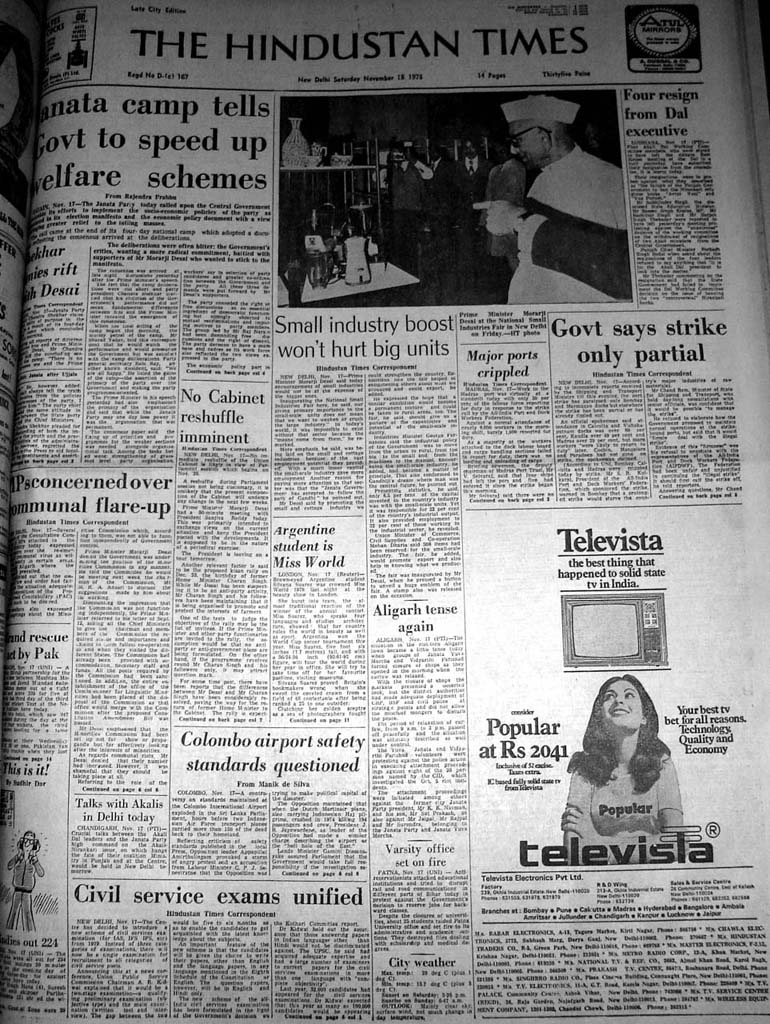
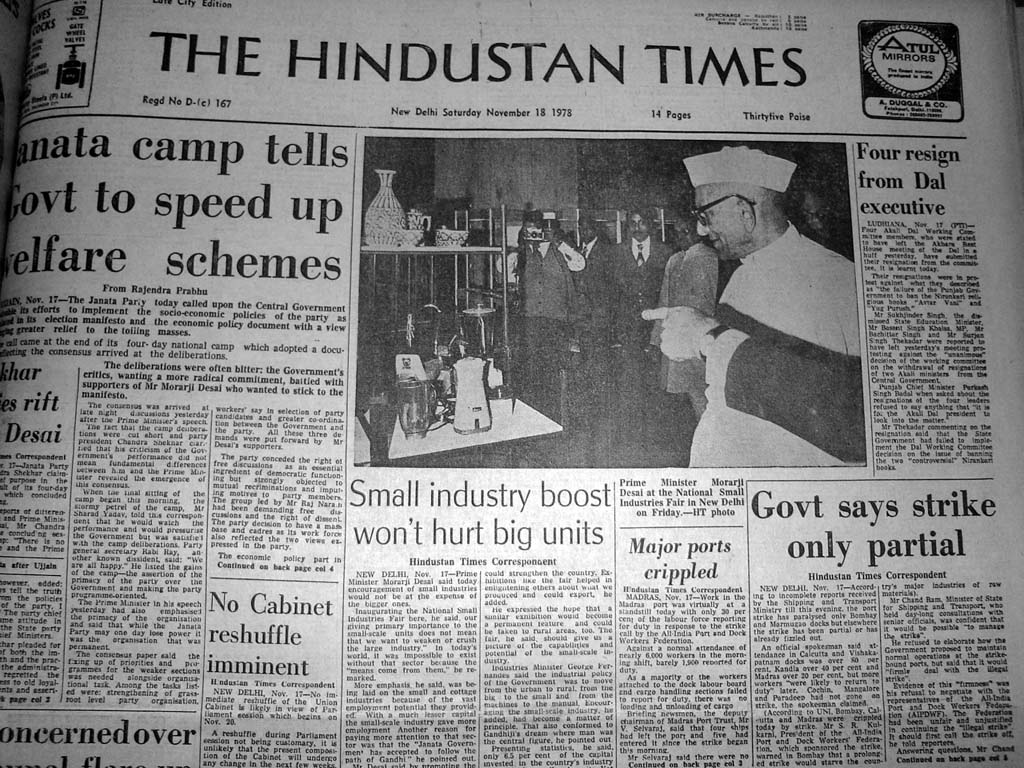
A Page from the Past

The Hindustan Times November 18, 1978

The Hindustan Times November 18, 1978

Click here for the complete post...

Friday, September 22, 2006

Why Delhi is Going Down

Today's Hindustan Times has an a page one anchor describing what a Dutch diplomat has to say about the capital of the nation:

Anything that can go wrong, does go wrong; everyone interferes with everyone else; the people are a darn nuisance; the climate is hell; the city a garbage dump... New Delhi is the most miserable place I have ever lived in.

Turn to the Edit Page, and the former Union Minister of Urban Development Jagmohan, an example of the difference between the well-meaning and the populist, puts forward the reasons behind this mess:

When, in 2001, I was functioning as the Union Urban Development Minister, I had launched an extensive drive against offenders of civic and planning laws. At that time, I had pleaded with my fellow members of Parliament to consider: "In what type of Delhi do we want to live, and what type of legacy do we wish to bequeath to posterity and to our children and grandchildren? Do we want our city to become a junkyard of unauthorised constructions or an orderly and disciplined capital of a resurgent Republic?"

The response of the power wielders to this plea was a sudden change in my portfolio.

Politics is a short run affair; all that matters is the next election. It didn't matter to Jagmohan, he lost his seat. Why worry about the long run? John Maynard Keynes said, "In the long run, we're all dead." Right. But others will live and with the shrinking time frame of long-run implications we are almost seeing the results live. Delhi is fast transforming into the gutter, once a river, which divides the city into two. Delhi Metro rail isn't the saving grace.

Click here for the complete post...

Saturday, August 05, 2006

HT

Hindustan Times

Click here for the complete post...

Tuesday, July 18, 2006

ET needs to know a little more of IT

ETThe first headline in today's Economic Times (New Delhi edition) screams, "WHO'S THE ENEMY. Terror attack sends blogs Paking." The sub-editor would be rubbing his hands in glee at the 'wonderful' pun in the headline. And I reading the morning paper was experiencing twitchy fingers, eager to blog about this.

The story reads

...it's still possible to get onto this site - but only by logging on through www.pkblogs.com, a site set up by Pakistani bloggers to get around the blog ban that their government had put in place after the Danish cartoons episode. In short, thanks to this new policy, a blog to help the victims of a possibly Pakistan-inspired attack can only be accessed through a Pakistani site!

Mark the word 'only' repeated twice. ET has been doing a decent job in decorating the pink paper with photos that I find suspiciously similar to results using Google Image Search; hence I assume that they know the five Ws and one H of the online world. Stating on the front page of the newspaper that pkblogs.com is the 'only' way to access the blocked blogs smacks of ignorance unexpected of the nation's leading pink paper. There a tens more, and that is what a relative ignoramus like me is aware of. You can also use good old Google to good effect.

The venerable Indian Express (a prime source of primary fodder for the Indian news industry) lists a few websites that have been blocked at the behest of the Department of Telecom. The list according to the newspaper includes princesskimberly.blogspot.com. Which when I checked it up, was last updated on March 24, 2005 and has but two posts. The older post describes a Harry Potter movie and the latter has this headline, "Who has the most boring life ever? I do!" Funny na? This whole episode seems ridiculous and our overzealous and underprepared media is adding to the merriment. Enjoy!

Update: ibnlive.com also lists Princesskimberly.blogspot.com. Don't these guys check the sites listed? Or is it that the person behind the 'sinister' Princesskimberly has changed the blog contents to evade trouble? Seems unlikely, as even the template used is the old blogspot one, hardly used nowadays. If this blog is indeed listed in the list that DoT sent out to the ISPs, it raises serious questions about the seriousness these guys in the government take their jobs. And also the counter checking that our scribes do before filing their stories? Or is it only a mere copy-paste job going on here?

Click here for the complete post...