Was playing around with the recently launched Google Insights for Search and discovered some interesting (some expected) trends. Though "Insights for Search applies a filter for search terms that may be explicitly sexual," it still is a lot of fun.

One thing that struck me is that Indians search for Google on Google the most.

But Indians are not the only ones, most countries have the term Google on the top 10 most searched terms (It should be kept in note that search for "Google" doesn't imply only Google, but also includes related terms like Google Earth, Google Maps. The title of the post was just to catch some attention). And the interest in Google has shown an increasing trend worldwide since 2004 to present (that's the maximum date range in Insights).
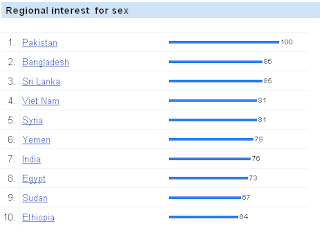
The next obvious term is "sex" and the Pakistanis rule the roost here. Followed by Bangladesh and Sri Lanka. India stands seventh in exhibiting interest for the search keyword "Sex". India's not-so-friendly western neighbour is also the numero uno in the hunt for "boobs", "breasts", "penis", "rape", "xxx", "nudity" and more (I have better things to do then exploit my neighbours' secret desires).
Within India Orissa stands first in 'sex search' followed by Delhi. Chattisgarh, Arunachal Pradesh, Tripura, Mizoram and Nagaland seem to be the least interested in such activities (the search volume index for the states read zero).
Trinidad and Tobago look for porn via Google the most. Bangladesh comes in second. United Kingdom is at number three. And most, obviously, look for "free porn".

Lesser developed countries seem to more eagerly seek their national identity online than more developed countries. A random search showed that the country name ranked as the top searched item in these countries (India is an exception).
Countries that have witnessed turmoil feature prominently in the search for "peace".

Some random snippets to end this post:
* Honduras is most interested in Paris Hilton
* Albania seems to have a huge Pamela Anderson following
* Americans like their guns, but followed in the second place by Iraq
* The US is still looking for WMDs on Google
* But Cameroon seems to be more interested in Saddam Hussein (US doesn't make it to the top of the list for Saddam Hussein searches)
* India seeks the most 'outsourcing', the developed world (besides Singapore) doesn't seem to care much
* Nepal has the hots for "Aishwarya Rai"
* Katrina Kaif is more popular in Pakistan than in India
* Salman Khan is a huge hit in Somalia. Nepal is a faraway second.
* The Somalis also drool over Kareena. Pakistanis are a distant runner-up
* Pakistan and Fiji are more interested in Bollywood than India
* The Kiwis seem to the most excited about the Olympics
* Indians express the most interest for "silicon implants", but the popularity of the term seems to be fading over time.
Do come up with more interesting Insights.
(The above 'findings' are just assumptions via my limited understanding of Google Insights for Search and should not be construed as real)
Click here for the complete post...
Collapse this post
 For someone like me whose exposure to Pakistani films was limited to the sub-standard fare aired on PTV, complete with the stereotyped villainous Hindu lala, a film like Khuda Kay Liye (In the Name of God - not an apt translation) was a pleasant surprise. Many of us would have heard about the film because one of India's finest actors, Naseeruddin Shah, played a brief but important role in the film. But beyond that it might not have interested many Indian movie freaks. But it should.
I too would not have watched the film, it had slipped off my mind, but a friend working for one of the numerous news channels wanted to do a story on this and sought my help in getting a copy of the movie, which I did. I later converted the film into a mobile friendly format and watched it during the 100-kilometre ride from Guwahati airport to Shillong. And even on the tiny 2" screen it was worth it.
The film to me was a dialogue between the liberal and extremist versions of Islam and for people with a limited understanding of the religion (that's a big number) it opens our eyes to many different facets. It portrays the dilemma of a Muslim in today's world. Here is a synopsis of the film from the website:
 The film is about the difficult situation in which Pakistanis in particular and the Muslims in general are caught up since 9/11. These is a war going on between the fundamentalists and the liberal Muslims. This situation is creating a drift not only between the western world and the Muslims but also within the Muslim community. The educated and modern Muslims are in a difficult situation because of their approach towards life and their western attire. They are criticised and harassed by the fundamentalists and on the other hand the western world sees them as potential suspects of terrorism just because of their Muslim names.
This paradox is resulting in great suffering for the forward looking Muslim. This is the name of the film 'Khuda Kay Liye,' which in English means In the Name of God.'
The interesting thing about the film is how it connects the happenings in three continents. Unlike the usual Indian and Pakistani films based on romantic sagas, dances and songs, this film is based on some very serious issues. Raising a lot of controversial questions engaging the Muslim minds these days. It helps the Muslim youth find a direction... the right direction, which we are all looking towards.
 Compared to the Pakistani films that I had watched before this, Khuda Kay Liye, is definitely miles ahead in all aspects, there's no comparison. The script is lucid and kept me engrossed throughout. The music is soothing. And performances are commendable. Though Naseer steals the thunder with his cameo.
The best part is that that Shoaib Mansoor, in his big screen debut as a director kept a very balanced approach. Though the point-of-view of the film is liberal, it does not outrightly rubbish the fundamentalists' approach. Even the logic behind the extremist interpretation of Islam is brought to the fore and a bulk of the counter arguments happen in the courtroom via Maulana Wali played by Naseer. The director makes an effort at not going overboard either with the story or with emotions, and succeeds.
Obviously the film met with a lot of protests and it a brave and commendable effort. It deals with a lot of issues which modern day Muslims face in an ever shrinking world and many do not agree with Mansoor's opinions as evident from the raging debates on online forums. But for an Indian the film makes for a must watch because today all that we seem to know about our neighbouring country revolves around one individual – General Pervez Musharraf.
I'm looking forward to the India release of the movie. Hope that happens soon, at least on DVD. In case it doesn't, just search for Khuda Kay Liye on Stage6, someone has uploaded the complete film in five parts. (you'll need to install DivX Web Player).
Here's a special Cutting the Chai edit of the trailer:
To share/embed this video click here
Download video [00:01:39 FLV 2.08 MB]
Related post: Watch Movies on Your Mobile
Click here for the complete post...
Collapse this post
 Watta match! It did live up to the tag of an Indo-Pak encounter. And India winning it made it even better. It was a thriller with all the twists and turns. And at last when the ball went sky high, millions of throats would've developed lumps on both sides of the LOC and only on one side were there shouts of exhilaration that followed. It was a match which will take this quickie form of cricket ahead.
Two teams bereft of some of the big names, ostensibly rested from a more youthful version of the game. Two teams who couldn't even make it beyond the first round of the 50-overs version of the World Cup went on to battle for the first ever Twenty20 World Cup. But then those teams were a little different from the 22 at the Wanderers.
The BCCI had initially phoo-phooed the idea of Twenty20 only to reluctantly embrace it. The launch of the Indian Cricket League opened the eyes of the custodians of the game of cricket in India to launch their own version of a domestic T20 league. Now with the success of the Indian team at the World Cup the BCCI is attempting to wipe off the egg on its face (it is by now quite used to it) with currency notes worth approximately rupees nine crore (that's what Ravi Shastri announced as reward for Team India and Yuvraj Singh on behalf of the BCCI).
Cricket it is said is a game of uncertainties and even an inept administration cannot always come in the way of a spirited team. Though there will be many clamouring to take the credit, it should always go to where it is due - the team.
And India also keeps it all win record against the arch rivals in both forms of World Cup cricket.
Click here for the complete post...
Collapse this post
 India versus Pakistan. World Cup Finals. What more can you ask for? Well, India to win in that encounter.
Prior to the ongoing Twenty20 World Cup at South Africa, I (and also millions of others like me) hadn't watched a single T20 matche. And when they did, I would say they were hooked. The longer versions of the game might have more grace, but this format of the sport isn't about gracefulness, it's just full throttle ahead. And everyone seems to enjoying the exhilarating pace.
Two teams who ingloriously exited in the very first round of the ODI World Cup early this year meeting in the finals of the World Championship of the new format of the game is good for the game. Because it is the Subcontinent which helps sustain interest in the game in all its formats and it is here where the money flows from. And the manner Yuvraj Singh is hitting the ball, the revenues have the potential of going higher than his sixers.
It was the success of the first World Cup (the Prudential Cup) in 1975 which brought One-Day cricket into the limelight and following South Africa T20 is here to stay. Just hope that in the future they don't narrow it down to the five-overs-a-side matches that we played in our locality.
And it feels good to see the Aussies humbled. This also is good for the game.
Click here for the complete post...
Collapse this post
 The headline may sound as sensational as if it was from one of the television news channels (who are a major source of worry for the K-queen Ekta Kapoor). Though any such possibility might seem remote now (but you never know the ways of war) an Edmundian, Nitya Anand Chepuri has conjured this idea in his novel Tarbela Damned - Pakistan Tamed.
I'm yet to read the book (will go looking for it today) but the plot does sound exciting, especially for a generation who have been brought up on the idea that our 'pesky' neighbour is the reason for all our ills. Two men who studied together in school - St. Edmund's Shillong - and then went on to IIT Madras. The Hindu, Rahul Sharma joins the RAW and the Jew, Solomon Rabban, migrates to Israel and joins the Mossad. The Irish Republican Army angle is due to the influence of an Irishman, Brother Manahan, who taught them in School (St. Edmund's is run by the Christian Brothers founded by Edmund Ignatius Rice at Waterford, Ireland). They join hands in pursuit of their mission, taming Pakistan.
There might be some parallels in the story line with the author's life who had studied in St. Edmunds before passing out from the Defence Services Public School and graduating from IIT Madras. He then went on to join the army. The reviews say that "there is no off-putting jingoism and no cold-bloodedness," which is indeed welcome for a novel with a title like Tarbela Damned - Pakistan Tamed.
Tarbela Dam, built across the river Indus, is Pakistan's largest dam and is therefore of vital importance for the country. And Pakistanis on hearing of an 'imminent danger' to it are understandably worried. Anand pointed me to a Pakistani military and strategic discussion forum, where some members took the plot of the novel for real and posted interesting reactions. Here are a few samples (unedited):* I can understand RAW and MOSSAD masterminding something but how does the Irish military come into this? Is this some troops in Afghanistan?
Anyway these dams need proper protection because RAW and MOSSAD can send mindcontrol zombies to do a suicide bombing on one of them. Dams are fragile and very hard to fix. I think its against the geneva convention to even bomb a damn during war.
* dams are not military targets, in war you are not meant to hit dams and if someone does then they will be nuked
* If the military stay in power then any such attack would be considered an act of war against pakistan. Doesn't matter who does it, Talibs or not, without dams pakistan would go down the drain. This is why we would ensure India goes down with us, meaning All nukes to indian and israeli cities. Also the factor of Indian nukes beng called a bluff, cause we're not sure if they can actually nuke us or not.
* Tell me a single time when the indian or israielies show honesty
* just imagine........
Bhakra Nangal Dam Damned, Bhangies tamed.
Ranjit Sagar Dam Damned, Bhangies tamed.
Gobind Sagar Dam Damned, Bhangies tamed.
Some comments were more realistic:* it was just a novel by an indian writer. The West, including Israel is not interested in de-stabilizing Pakistan.
Well, I learnt another thing from the thread. Indians are referred to as Bhangies across our western border - maybe due to the still prevalent caste system in our country.
Most well-meaning Indians do not want an instable western neighbour even though we might have fought many wars, the scars of which might take long to heal. Pakistan's stability is good for India. Being surrounded by so-called failed states is a precarious situation in today's volatile times. If India has to develop into a super power that it aspires to be, there has to be political stability and economic growth in all of South East Asia. Because the ground realities here are much different from what existed in the American continents.
You can find more details about the book here.
[Tarbela Damned - Pakistan Tamed
By CN Anand
Published by Indialog Publications
198 pages
Rs 195]
Click here for the complete post...
Collapse this post