A glass of steaming milky syrupy tea is best served cut. One by two or two by three, it embodies the spirit of sharing and camaraderie (and more significantly a resource crunch). Come, have a sip.
...or at least some people at The Indian Express think so. I wouldn't have otherwise posted about this 'oversight', but for the fact that the news item in question appeared in the 'From the Northeast' page of the newspaper.
The news was about an altercation between two groups of students ('locals' versus 'outsiders') at the North Eastern Hill University (NEHU), my alma mater.
To add to further ignorance, the accompanying photo carries a caption that mentions the name of the university (NEHU) as Sikkim Manipal Institute of Technology. It is possible that this photo is possibly related to another unrelated incident.
The Express is one of the very few national newspapers that give regular coverage to the otherwise neglected North Eastern India and I assume that the people in charge of the page would at least be aware of the geography of the area.
I wouldn't blame the reporter Tilak Rai for the gaffe, Tilak has been reporting from the region for quite some and would know where Shillong is.
Though, on IndianExpress.com, they seem to have made amends to the headline but the body of the story still mentions 'Sikkim'.
For those who didn't take their geography classes in school seriously, Shillong is the capital of the state of Meghalaya located south of Assam. Sikkim is a different state, north of West Bengal and the capital of Sikkim is Gangtok.
Also the largest university in Shillong is the North Eastern Hill University (also known as NEHU), a Central University.
Four days - that must be the maximum in years that I've been away from the internet (well, not actually... I did check a few sites in between on my cell phone... but that doesn't exactly count. Does it?).
I would have liked to keep the judai (separation) for a while longer, but my boss didn't let it be. Had to log on to send some 'important' emails. And when you are online you just cannnot resist the temptation to check the updates on GMail, Blogger, Twitter, feed reader, LinkedIn, Facebook, Orkut and so many more. I couldn't resist posting a post.
The reason is that I'm away on a vacation, a few marriages to attend and a little booze to drink.
Tomorrow I'll be leaving for Silchar in South Assam for four more days - so more four days away from the net (I'll be Twittering though). I'm not getting any withdrawal symptoms. Yet.
By the way, the smoking ban doesn't seem to have any effect on the bars in Shillong. Actually the waiter was surprised that we asked him the question.
And kids here too are playing terrorist-NSG games. Disturbing.
Planning to go to an interesting museum today. Will post if I find anything interesting.
Three women, three kisses, three heartbreaks, a couple of apologies that's Bachna Ae Haseeno (BAH). But this post isn't about BAH it's about Dilwale Dulhaniya Le Jayenge (DDLJ) (English title: Braveheart Will Win the Bride), that super-duper hit, a film that BAH pretends to be an extension of (parasite would be more appropriate).
People tend to boast of the number of times they have watched a particular movie, usually Sholay tops such a list, but DDLJ too is a worthy competition. I have actually lost count for both the films, though Maahi's (Minnisha Lamna) count was 17. The other day, a friend from Bangalore called up to enquire which year we passed the secondary school exams (he was at an interview and was filling up those unending HR forms). "Abbey 1995. DDLJ release hua tha na us year," I replied. For my generation it perhaps released at the perfect time. It has become a sort of a landmark.
I still remember the first show, three of us schoolmates - two boys and a girl - bunking school and sitting in the second class seats of Shillong's Payal Cinema (the tickets for the cheapest seats cost us Rs 40 each in black. The actual price back then was Rs 1.65). The release then was a rarity for Shillong - a film hitting the city's screens on the same day as the rest of the country. We usually had to wait for a few months, by then half the city would have already watched it on video tapes. Huge posters of Kajol and Shah Rukh were plastered all over. "Come fall in love," they said. When the film ended I told the female friend that I'll come back for more.
Come back I did. As the shows went by I didn't need to purchase tickets in black anymore and could enjoy the luxuries of the balcony (Rs 5.10) or the Dress Circle/Payal Circle (Rs 6.10). During the winter vacations twice or thrice a week I ventured out alone to Payal Cinema and watched Raj romance Simran and win over everyone on and off the screen.
The Raj bug hit many of us hard. A friend actually turned into a SRK in DDLJ clone and thereby earned the affections of many a female. Even today, whenever I happen to come across the film on TV, I give the remote a little rest for a while.
Aditya Chopra had indeed made a brilliant film, something that cannot be replicated. The story, the music, the performances - all had an endearing charm about it. From snowy Switzerland to mustard yellow Punjab the trip has us in a trip. The Rajs of the world looked for their Simrans and vice versa.
DDLJ also introduced me to another thing Stross beer (in film advertising works). It was the first beer that I tasted and I had made a pen stand out of that very first beer can. I think I still have that somewhere.
Though I didn't go out shopping for the leather jacket and the cap or joined mandolin classes, I did look for those little lockets that SRK wore, without success.
Another thing that I happened to notice, DDLJ perhaps began the trend of movies deriving their titles from popular songs. Nowadays every other movie does so.
In the usual post-movie alternative endings discussions, one question was common - what if Raj was unable to reach out to Simran and pull her on the train? What if?
Nothing much. His Pops would have pulled the chain.
While the dilwale took away the dulhaniya we all sat and fell in love.
I can't say anything that hasn't already been said, but growing up in a post-Independence India devoid of heroes, he was one of the few our elders taught us to adulate.
I studied for a few years at the Kendriya Vidyalaya (Central School) at Happy Valley, Shillong, which is set amidst the 58 Gorkha Training Centre (58 here stands for 5 and 8). And there dedicated to the now departed Field Marshall and honorary Gorkha is a museum. The next time I visit home will make it a point to say hi to Sam Bahadur memorabilia.
But, the political leadership and the top military brass do not seem to share similar sentiments.
It doesn't get cheaper than this. Seems to be worth the wait, but then will have to take a test drive first and that seems to be some months away.
The Nano (or the Rs 1 lakh/$2500 car - the cheapest in the world) is a a rear-wheel drive, all-aluminium, two-cylinder, 623cc, four-door five-seater car.
It is 3.1 metres long, 1.5 metres wide and 1.6 metres tall and reports say that it gives a mileagle of 23km/litre.
On second thoughts, I'll wait for a year and then get a second-hand, or to use an euphemism, a pre-owned Nano.
Meanwhile, all wannabe taxi drivers back home in Shillong would be wondering about how viable would it be to negotiate a 30 degree incline with seven people inside (yes they will manage to squeeze in seven, if not more) on a 623cc engine.
But then if the 173.52cc autorickshaws can manage to crawl up the hill, the Nano would surely fare much better. As for Delhi, it wouldn't make much of a difference, there's not much difference at 10kmph.
The assembly elections in the state are quite a few months away, but from the look of the narrow and winding roads of Shillong it seems that canvassing is on in full swing. And all the parties are rooting for the same candidate.
On entering the city a huge hoarding sponsored by the state Youth Congress Chief asks you to vote. Further down into the city, the BJP has also put up banners appealing you to vote for the very same contestant - Amit Paul.
Many television viewers are by now quite familiar with the name. Amit Paul is the Shillong lad who has made it to the final two in one of the numerous TV musical talent shows - called Indian Idol. And for the hill state of Meghalaya and its sleepy cosmopolitan capital Shillong it seems to be the best thing to happen since January 21, 1972 - when the state of Meghalaya was carved out of Assam. For a city with its soul soaked in music the zeal expressed in support of a local lad coming to the verge of getting a ticket to the 'big league' might not seem surprising. But the feverish excitement over a TV show is something that someone like me finds tough to comprehend.
People from other cities from where boys and girls have been contenders for the big promises of the talent shows might have been witness to similar phenomenon. I also had, last year, when Debojit Saha from south Assam had gone to the SaReGaMaPa contest on Zee TV (he was the eventual winner but not necessarily not the most talented of the lot) and I happened to be on a visit to that part of the country.
Amit Paul is already an icon in Shillong. Almost everyone is talking about him all the time. From the barber to the taxi driver, the point of discussion is Amit. Giant screens have been put up all over the city so that people can watch 'their boy' in action. MLAs and MDCs (Member of District Council) are falling over one another to sponsor free PCOs from where the public can punch in their votes for Amit.
Rallies in support of Amit are a daily affair and the crowd at the one when Amit came visiting home is said to be the largest that the city had ever witnessed. The last time Shillong saw people turning out on the roads voluntarily in huge numbers was when the body of Kargil martyr Captain K Clifford Nongrum was brought home.
Amit t-shirts line shop windows and his posters are best sellers (though some organisations have urged them to be distributed for free). Wherever you look in the city you cannot possibly miss one face with a slight stubble looking at you from all directions.
The swanky touch-screen mobile phones are no longer the latest show-off here, it is the number of votes that one has cast for Amit. An elderly gentleman who occupied the seat next to me in a local taxi (taxis in Shillong usually ply on a sharing basis) said that he voted 500 times. Others have reportedly sent over a thousand votes for their home-bred contestant. And the voting continues throughout the night.
To have a first-hand look I walked through the semi-deserted streets to one of the free PCOs at around midnight to discover a huge crowd there. People of all ages, pre-pubescent girls and elderly grandmothers all queuing up in a pleasant September night to vote for Amit. Occasionally some slogan shouting in support of Amit breaks the silence of the night.
For a city which is used to shutters downing a couple of hours after dusk (the sun sets early in the east) these energetic midnight ventures by the young and the old is indeed welcome.
What else is also welcome is that in a communally divided and sensitive society like Shillong's the success of Amit Paul has brought about an unprecedented sense of togetherness.
Amit Paul is Bengali, his family owns a renowned clothing outlet in the centre of the city - Shankar Brastalaya - and at the forefront of the campaign in support of Amit are the Khasis (both communities - Khasis and Bengalis - over the last few decades haven't shared the best of relations). Now both, along with the numerous other communities who inhabit Shillong are making a collective effort towards realising the recently realised dream of a city-bred Indian Idol.
But then there is also a dark side to this tale. Amit's competitor for the title of Indian Idol is Prashant Tamang, hailing from Darjeeling, and sceptics believe that Shillong's Nepali community (a sizeable one) is voting for Prashant, while according to them the loyalties of of all the people of Shillong should be with the city and not the tongue one speaks in.
In case Prashant betters Amit in the vote count there are apprehensions of disturbances in Shillong, which has fortunately been quite peaceful (communally) for the last few years.
To add to all the confusion are rumors of free SMS services being provided by mobile operators leading to many people sending as many SMSes as possible. Apart from the freebie seekers there are many deep pockets abound distributing free pre-paid cards to anyone willing to punch in the SMSes in Amit's favour.
Amidst all the brouhaha it is obvious that there would be a few who can see though this maniacal euphoria (thankfully there are). These few realise that the producers of the show are merely triggering the upheaval of regional emotions and filling their (and the mobile operators') coffers and are also aware of the real value of such talent hunts at a time where every channel boasts of one, if not more such shows. They also try to recall the previous winners of such shows and the oblivion where most of them have disappeared into and also the process of multiple public voting which turns a so-called democratic exercise into a farce.
A local columnist Patricia Mukhim is believed to have ignited the fire for Amit through her columns in the local newspapers. Then socio-cultural organisations took over and even the government couldn't resist from staying behind. The Meghalaya government has declared Amit Paul the 'Brand Ambassador of the State of Meghalaya for Peace, Communal Harmony and Excellence' (see the adjacent image of a copy of the letter from the Chief Secretary) and even the Governor signed his fan book.
With many of Shillong's lasses already publicly expressing the desire to marry him, Amit might just face another problem of plenty. A Sikkim-based businessman has announced a Rs One crore funding for voting in favour of Prashant. There are also rumors of the government employees of Sikkim contributing a day's salary to the kitty for Prashant.
May the best man win, but they seldom do in the farce that these talent hunts are.
Special addition: [September 19, 2007] In fear of excommunication by fellow Shillongites and the possibility of being denied entry into the city in the future for daring to question the concept of TV talent shows at a time when Amit Paul has made it to the finals of Indian Idol 3, here's an attempt towards pacifying the die-hard fans of Shillong's latest singing sensation - some childhood and teenage photographs of him (Don't ask me whether I voted for him or not).
The news is that I have quit my present job (don't say not again!) and am taking (a well deserved) break at home in Shillong. The national news media didn't inform me, but this part of the country is displeased with the plenty that the rain gods had to offer. Large parts of Assam is underwater and even Shillong (a hill station) witnessed flodding.
Landslides accompany the rains and take away the life and property down the hill. The Guwahati-Shillong highway (National Highway 40) is in a mess. The skies are perpetually overcast but the mood is upbeat. Because of a TV talent show called Indian Idol, now in its third season. Interesting experiences here, will post the details later.
The headline may sound as sensational as if it was from one of the television news channels (who are a major source of worry for the K-queen Ekta Kapoor). Though any such possibility might seem remote now (but you never know the ways of war) an Edmundian, Nitya Anand Chepuri has conjured this idea in his novel Tarbela Damned - Pakistan Tamed.
I'm yet to read the book (will go looking for it today) but the plot does sound exciting, especially for a generation who have been brought up on the idea that our 'pesky' neighbour is the reason for all our ills. Two men who studied together in school - St. Edmund's Shillong - and then went on to IIT Madras. The Hindu, Rahul Sharma joins the RAW and the Jew, Solomon Rabban, migrates to Israel and joins the Mossad. The Irish Republican Army angle is due to the influence of an Irishman, Brother Manahan, who taught them in School (St. Edmund's is run by the Christian Brothers founded by Edmund Ignatius Rice at Waterford, Ireland). They join hands in pursuit of their mission, taming Pakistan.
There might be some parallels in the story line with the author's life who had studied in St. Edmunds before passing out from the Defence Services Public School and graduating from IIT Madras. He then went on to join the army. The reviews say that "there is no off-putting jingoism and no cold-bloodedness," which is indeed welcome for a novel with a title like Tarbela Damned - Pakistan Tamed. Tarbela Dam, built across the river Indus, is Pakistan's largest dam and is therefore of vital importance for the country. And Pakistanis on hearing of an 'imminent danger' to it are understandably worried. Anand pointed me to a Pakistani military and strategic discussion forum, where some members took the plot of the novel for real and posted interesting reactions. Here are a few samples (unedited):
* I can understand RAW and MOSSAD masterminding something but how does the Irish military come into this? Is this some troops in Afghanistan?
Anyway these dams need proper protection because RAW and MOSSAD can send mindcontrol zombies to do a suicide bombing on one of them. Dams are fragile and very hard to fix. I think its against the geneva convention to even bomb a damn during war.
* dams are not military targets, in war you are not meant to hit dams and if someone does then they will be nuked
* If the military stay in power then any such attack would be considered an act of war against pakistan. Doesn't matter who does it, Talibs or not, without dams pakistan would go down the drain. This is why we would ensure India goes down with us, meaning All nukes to indian and israeli cities. Also the factor of Indian nukes beng called a bluff, cause we're not sure if they can actually nuke us or not.
* Tell me a single time when the indian or israielies show honesty
* just imagine........ Bhakra Nangal Dam Damned, Bhangies tamed. Ranjit Sagar Dam Damned, Bhangies tamed. Gobind Sagar Dam Damned, Bhangies tamed.
Some comments were more realistic:
* it was just a novel by an indian writer. The West, including Israel is not interested in de-stabilizing Pakistan.
Well, I learnt another thing from the thread. Indians are referred to as Bhangies across our western border - maybe due to the still prevalent caste system in our country.
Most well-meaning Indians do not want an instable western neighbour even though we might have fought many wars, the scars of which might take long to heal. Pakistan's stability is good for India. Being surrounded by so-called failed states is a precarious situation in today's volatile times. If India has to develop into a super power that it aspires to be, there has to be political stability and economic growth in all of South East Asia. Because the ground realities here are much different from what existed in the American continents.
Tintin and his loveable whisky-loving and faithful fox terrier friend Snowy kept me in adventurous company during many a rainy afternoon. I owned very few of Tintin comics, the price was a big deterrent, but read almost all of them thanks to the comic exchange programme that we friends practiced. One which I missed was the very first one, published in 1929, Tintin in the Land of the Soviets (the other was the last but semi-complete - Tintin and Alph-Art).
Wilfing on the Internet the other day, I accidentally discovered Tintin in the Land of the Soviets on Scribd. Though the artwork in Tintin's first adventure is a far cry from the ones later ones which carried our young reporter (though he's rarely seen doing what reporters usually do) and his four legged friend to different parts of the world (including India, particularly the kingdom of Gaipajama, complete with all the stereotypes of fakirs and the Indian Rope Trick).
The comic book though meant for children is also a critique on different existing political systems. Be it the coup curry of Latin America or the Japanese interference in China. Hergé or Georges Remi (this was a favourite question of quizzards during our time as the name Hergé is a result of transposition of Georges Remi's initials) did support monarchy as depicted by Tintin's friendship with the Maharaja of Gaipyjama or his help for King Muskar XII of Syldavia in King Ottokar's Sceptre. Tintin in the Land of the Soviets shows the Bolsheviks in a very poor light (very unlike what we were taught in the school texts during our time) and this was perhaps the reason why the comic was not available in India. A few examples:
Tintin had inspired a number of people to produce unofficial comic books - one being Tintin in Thailand where Tintin goes on a 'sex holiday' to Thailand (it also features almost all of the major characters) - and I too produced one. I was 14 and in Class VIII when I put my very own Tintin adventure on paper (with pencils, a black Pilot pen and Camlin sketch pens), titling my work Tintin in Shilliont, keeping alive Hergé's tradition of fictitious lands based on real places. Shilliont was Shillong. But unfortunately, I lost that comic. If I remember right, Kisholay Ray (now a budding photographer), a good school pal, who had a much better hand at drawing than me also had his own version.
Though an animated series on the Adventures of Tintin had appeared on television, which I rarely missed (now I'm again rerunning them on my mobile), nothing beats the experience of the comic book in paper.
[Generously lifting an old post because the feeling remains unchanged. I'll be away from Delhi and also possibly blogging for the next five days. A short trip home (after a year) and I hope to make it sweet]
The sun plays hide and seek with the nimbus clouds, the moss between the toes is cold, damp. The acidic smell of pine leaves lends freshness to the air. It's getting colder. The winds of November whistle through the bamboo groves. Winter is almost here. She reminded the British of their Scottish highlands. 1496 metres tall, she's beautiful, she's Shillong.
Simon and Garfunkel wished to be home. Here I am with a wish come true - suitcase minus the guitar in hand - homeward bound. Leave sanctioned, bags packed, tickets printed, I should be home tomorrow. The blog posts will be a little irregular, but when I'm back I should have some to tell. Shillong here I come...
Homeward Bound
I’m sittin’ in the railway station Got a ticket for my destination On a tour of one night stands My suitcase and guitar in hand And every stop is neatly planned For a poet and a one man band
Homeward bound I wish I was Homeward bound Home, where my thought’s escaping Home, where my music’s playing Home, where my love lies waiting Silently for me
Everyday’s an endless stream Of cigarettes and magazines And each town looks the same to me The movies and the factories And every stranger’s face I see Reminds me that I long to be
Homeward bound I wish I was Homeward bound Home, where my thought’s escaping Home, where my music’s playing Home, where my love lies waiting Silently for me
Tonight I’ll sing my songs again I’ll play the game and pretend But all my words come back to me In shades of mediocrity Like emptyness in harmony I need someone to comfort me
Homeward bound I wish I was Homeward bound Home, where my thought’s escaping Home, where my music’s playing Home, where my love lies waiting Silently for me Silently for me Silently for me
The reasons for us to watch Jag Mundhra's films during school and early college years were obvious. Now when his latest venture Provoked released, I didn't have the urge to spend money and time to watch his work featuring Aishwariya Rai (now Bachchan). Since it was very unlikely for Aishwarya to be doing a Helen Brodie[NSFW].
Last night, on the way back from work I heard the OST of the film for the first time and one song touched my heart. Again for obvious reasons. The song was titled 'Shillong.' Sung by Karen David, who traces a part of her ancestry to the beautiful hill city. Karen also has plays a role in the movie.
One of the little excitements during our school days was to gaze at the film posters - on the walls of the Shillong Civil Hospital - as our rickety school bus brattled by. The posters usually changed every Wednesday or Thursday and had a rectangular piece of printed paper pasted atop providing details about the name of the cinema hall and the show timings. There were only a handful of cinema halls - Bijou, Payal, Dreamland, Mini Dreamland (below Dreamland and popular for B-grade stuff) and Anjalee (for all the foreign flicks). There was a Kelvin too (very popular with my parents as it showed Bengali movies), but then it burned down one night, and Singhania Talkies which the Ramakrishna Mission took over and turned it into a library. Besides there were the military run theatres (Rhino, Soltee and the like).
After Kelvin turned into ashes, I hardly ventured into the dark environs of the theatre and by that time the VHS revolution had begun. We pooled money and rented video cassettes and the VCP. It was a regular affair every week (sometimes on all days of the week) and there was hardly a film from that era that we would've missed (only the ones with 'scenes' in them, as it was more of a family show). Come back from school, change fast, gobble something and rush to the neighbour's drawing room which served as our theatre for many years. But we didn't like to miss the posters on the walls of the Civil Hospital. Usually printed versions of hand-painted posters, where often an untrained hand gave the hero a villanish tinge or add some unwanted kilos (at the wrong places) on the heroine. The artists took extra care in accentuating the muscles of the hero and the bust of the female lead. The vamp gave them more liberty. With the popularity of photographic images on film posters, the look might have gotten better, but the feel is amiss. Every poster painter (even MF Hussain was one) had his unique take. I watched in awe as a giant Amitabh, Govinda. Anil Kapoor or Mithun towered over me from the top of Dreamland Talkies. Red with anger or pink in love, the blue of the evil, the brushstrokes said it all. Now missing from the walls these hand-painted movie posters are found inside art galleries ready to be the prized possession of the highest bidder.
Another source for film posters for me was Screen (bought every week by my brother), it didn't (then) have any of the movie industry masala that the other magazines carried. It was more about the business of making movies and selling them. For me the full page broadsheet posters were a big bonus. After my brother lost interest, I started getting the copies on my own. If I remember right, it cost me Rs 5. Then I too ventured off the filmi fare. Years later, I couldn't find it on the vendor's display, only to realise later that the look had changed (like so many of the newspapers and magazines).
The film poster as a medium of advertising is intriguing. At a time when there was no television (or the internet), it was the posters which let the public know about the forthcoming releases. Newspapers also carried miniature posters where they announced the show timings. Even Chitrahaar (that great favourite on Wednesday and Friday nights) displayed the poster of the film before playing the song.
Here's a little tribute to the almost extinct art of hand-painted film posters, featuring ten milestone Hindi films (I like the term Hindustani over Hindi as an adjective for Bollywood movies):
It might be an aftereffect of what the television news media had been feeding me for so long, usually against my wishes. I normally avoid getting angry or more precisely, expressing my ire. But when obstructive stupidity gets out of hand I can barely contain myself. The same happened yesterday.
After a long day at work I boarded a bus, which the internet had told me a few hours ago was the maiden run of the Uttar Pradesh Transport Corporation operated Nodia-Delhi city bus service. Since not many were aware of that, the bus was relatively empty and I easily got a seat (though not a coveted window seat). "Good," I thought, "I'll reach Connaught Place early and comfortably to catch a connecting bus to a friend's place." Thanks to our dear obstructive media it was not to be. The bus came to a halt near the Akshardham Temple (a perfect example of how much money some Indians can spare in the name of religion). Minutes ticked by and I couldn't make out anything as there was a crowd near the front door and I didn't want to stand up and have a look, lest I lose my seat (the bus was quite crowded by that time). More minutes went by and I asked someone at the front what was happening. I heard the words "Aaj Tak." I waited. The longest hand in my wrist watch took a few more rounds. I began to lose my patience and then the perpetrators came into the picture, for a few more bites from passengers inside the bus. A frail looking journalist wielding a microphone with Aaj Tak and sister-channel logos, accompanied by a somewhat lost looking cameraperson with a compact video camera (they might have the features, but size does matter for that professional look).
Now I could see the driver. I asked him to start the bus, as people were getting late. He responded in a warning tone, "TV waale hain (these are TV people)" "To kya? (So what)," I asked. "Yahan logon ko late ho raha hain (People are getting late here)." I could hear some voices in my support from the rear. She tried to dissuade without success the aggravated voices saying that it was a historic journey that we were undertaking and the people needed to know about this. "Don't stop the bus for that," I retorted. The reporter got offended and asked me not to interfere as she was doing her duty. At which the long-asleep idealistic trained journalist within me awoke and asserted the fact that I too knew what journalism was and what are the duties and more importantly the rights of journalists.
Journalists are immune to public anger, I know that. The two, visibly shaken, were still reluctant to disembark or let the bus ply. The driver was too dazzled by the media interest in his bus. Then I used the old trick that usually works in a city (and country) that runs on connections. A call to another journo pal making some threatening noises put the bus back in gear. The newsgatherers disappeared and I reached my destination. Late.
So long we only had VIP movements delaying citizens. Now we also have media activity. This reminds me of an old post
And on an entirely different note, Shillong, my hometown, added another laurel to her cap. This time it's a world record. Though I'm blogging about this late (and in fact I published this post last night even without completing it. Continuing from where I left), I would like to share the news. Here's The Shillong Times story:
[This was published a good seven years ago in the 1999 issue of the Edmundian - St. Edmund's College Magazine, which also happened to be the special platinum jubilee commemoration issue. The self-praise might seem exaggerated to others, but I wrote (somewhat amateurishly) what I believed in and am reproducing it here, unedited. Many batches have passed since, some facts may have changed, but the core remains.]
In this world there is always something which is better than others. We Edmundians belong to the better category. This is not only due to our academic brilliance but also due to what we call the "Edmundian living." It is this living life the Edmundian style that makes St. Edmund's distinct as it is. This philosophy may not be easily comprehended by someone who has not spent a few good years of one's life within its colossal campus. The Edmundian spirit can only be experienced and not heard, seen or read about.
To the outside world we people behind those iron gates and netted fencing may appear to be a different species altogether. Yes, we are a distinct bunch but at the same time down to earth humans too.
When a student first steps into this wooded mammoth campus he initially is in a dilemma in finding his way in and out but gradually he knows this campus as the palm of his hand, every nook and every corner, the many fields, the main five entries and exits, the numerous corridors and rooms etc... etc.
In its glorious three quarters of a century of existence St. Edmund's has produced thousands of successful individuals in every field of life and they will not disagree with me when I say that they had spent some of the best years of their life out here.
The main charm of being an Edmundian is not essentially attending lectures and sitting in the library drowned in texts. By this I do not mean that our lecturers are not good or our library is not up to the mark. In fact, our teachers are amongst the best in the field and the library is a wonderful place to be in and moreover we also have a gem of a librarian in there. These things are nevertheless important as they form the core of an Edmundian's life but we have varied interests in other fields too. To pursue these interests the time offered by off-periods and breaks are never enough, therefore more often than not we have to resort to bunking class. This indeed is also an art which most of us Edmundians have mastered. This includes calculating the amount of bunkable classes, proxy attendance and escaping 'unhurt' when accidentally coming face to face with the Principal or other teachers ... the tricks of these trades are highly sophisticated and are well guarded secrets from the administration. We are therefore able to get away with this but not initially when we are yet to learn the tricks of the trade but once it is learnt we become absolute masters.
We often fantasise about many things in the college. One fantasy being the thought of lighting up all those fireplaces in the older part of the college on a rainy winter day, another being playing the Edmundian Open on the concrete tennis courts and the third is, mainly of the students of the arts stream, to have females in their classes too.
Without trying one's hand at the handball alley and a few cricketing strokes in the adjoining field and the basket ball court and now buried under tnnes of mud, the so called Dhobi Field, one does not become a full fledged Edmundian as all these are a part and parcel of the Edmundian's way of life.
The library and canteen may be amongst the favourite hangouts within the college but their respective disadvantages being that in one silence is required and the other is located right at the heart of the college. Therefore, the outstation venues like Down Shop and Volga who take the cake in this category. Other hotspots within the campus being the triangular lawn besides the office (which I think should be given a name) and beneath the trees in front of the New Hostel.
One drastic change which has come most recently in the lives of many Edmundians is the opening of its wrought iron gates to the fairer sex. It has ended an era of male domination in one of the best colleges in this part of the country and therefore may have hurt the egos of a few but the coming of the girls brought about a variety in the campus and gave us guys an additional reason to be present in the college regularly and also cut of drastically our mandatory once a day visit to Don Bosco Square.
The vast diversity in the student population of St. Edmund's, their immense talents, their carefree and fun loving ways and the support of a meritorious faculty and its exquisite campus makes the Edmundian living the wonderful experience that it is.
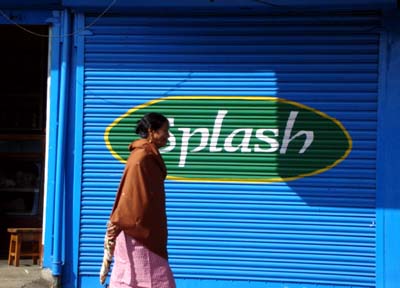
A Khasi lady walks past a downed shutter in Shillong's Mawlai locality (which though in Shillong is a separate census town. And the town of Mawlai within the city of Shillong constitutes of 15 different villages - 14 with the prefix Mawlai and one Umshing Mawkynroh).
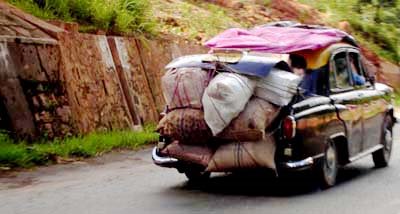
The sturdy Ambassador - running on Indian roads since 1957 - may have lost its clientele. Once upon a time the Prime Minister to the bada babu all rode the Amby (those were the days of socialistic leanings). The PM now rides a German BMW. The bada babu has bought himself a Honda City. On the hills, where the incline is steep and the load is heavy, some Mark IIIs and IVs still ply - loyally.




 ...or at least some people at The Indian Express think so. I wouldn't have otherwise posted about this 'oversight', but for the fact that the news item in question appeared in the 'From the Northeast' page of the newspaper.